Week 15 Continue Cather


The
Joy Luck Club (1989) is a best-selling novel written by Amy Tan. It focuses on
four Chinese American immigrant families in San Francisco who start a club
known as The Joy Luck Club, playing the Chinese game of mahjong for money while
feasting on a variety of foods. The book is structured somewhat like a mahjong
game, with four parts divided into four sections to create sixteen chapters.
The three mothers and four daughters (one mother, Suyuan Woo, dies before the
novel opens) share stories about their lives in the form of vignettes. Each
part is preceded by a parable relating to the game.
In
1993, the novel was adapted into a feature film directed by Wayne Wang and
starring Ming-Na, Lauren Tom, Tamlyn Tomita, France Nguyen, Rosalind Chao, Kieu
Chinh, Tsai Chin, Lisa Lu, and Vivian Wu. The screenplay was written by the
author Amy Tan along with Ronald Bass. The novel was also adapted into a play,
by Susan Kim, which premiered at Pan Asian Repertory Theatre in New York.

Amy Tan (born February
19, 1952) is an American writer whose works explore mother-daughter
relationships. Her best-known work is The Joy Luck Club, which has been
translated into 35 languages. In 1993, the book was adapted into a commercially
successful film.
Tan has written
several other bestselling novels, including The Kitchen God's Wife, The Hundred
Secret Senses, The Bonesetter's Daughter and Saving Fish from Drowning. She
also wrote a collection of non-fiction essays entitled The Opposite of Fate: A
Book of Musings. In addition to these, Tan has written two children's books:
The Moon Lady (1992) and Sagwa, the Chinese Siamese Cat (1994), which was
turned into an animated series which aired on PBS. She also appeared on PBS in
a short spot encouraging children to write. Tan is also in a band with several
other well-known writers, the Rock Bottom Remainders.
Fragile: easily broken
or damaged: very delicate: not strong
Fragment: a
broken part or piece of something: an incomplete part
Human sexuality is the
capacity to have erotic experiences and responses. A person's sexual
orientation may influence their sexual interest and attraction for another person.
Sexuality can have biological, physical, emotional, or spiritual aspects. The
biological and physical aspects of sexuality largely concern the reproductive
functions of the sexes (including the human sexual response cycle), and the
basic biological drive that exists in all species. Physical, as well as
emotional, aspects of sexuality also include the bond that exists between
individuals, and is expressed through profound feelings or physical
manifestations of emotions of love, trust, and caring. Spiritual aspects of
sexuality concern an individual's spiritual connection with others. Sexuality
additionally impacts and is impacted by cultural, political, legal, and
philosophical aspects of life. It can refer to issues of morality, ethics and theology,
or religion.
Interest in sexual
activity typically increases when an individual reaches puberty. Some
researchers assume that sexual orientation, or sexual behavior as a result of
it, is determined by genetics, and others assert that it is molded by the
environment, or is a combination of both biology and environment. This is the
nature versus nurture debate, in which one can define nature as those
behavioral traits that are due to innate characteristics, such as instincts and
drives. The concept of nurture can be defined as the environmental factors or
external stimuli that influence behavior, emotions, and thinking.
Evolutionary
perspectives on human coupling and/or reproduction, including the sexual
strategies theory, provide another perspective on sexuality, as does social
learning theory. Socio-cultural aspects of sexuality include historical
developments and religious beliefs, including Jewish views on sexual pleasure
within the marriage and certain Christian or other religious views on avoidance
of sexual pleasures. Some cultures have been described as sexually repressive.
The study of sexuality also includes human identity within social groups,
sexually transmitted infections (STIs/STDs) and birth control methods.
It’s not about right
or wrong, it’s about choice. (Free will)
Elaine Showalter (born
January 21, 1941) is an American literary critic, feminist, and writer on
cultural and social issues. She is one of the founders of feminist literary
criticism in United States academia, developing the concept and practice of
gynocritics.
Best known in academic
and popular cultural fields, she has written and edited numerous books and
articles focused on a variety of subjects, from feminist literary criticism to
fashion, sometimes sparking widespread controversy, especially with her work on
illnesses. Showalter has been a television critic for People magazine and a
commentator on BBC radio and television.
A Literature of their
Own
The famines
The female
The feminist
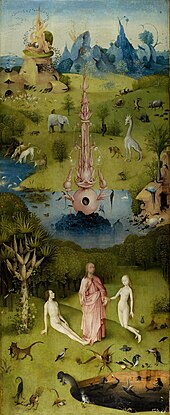
The Garden of Eden
(Hebrew גַּן עֵדֶן, Gan ʿEdhen) is the biblical "garden of God",
described most notably in the Book of Genesis chapters 2 and 3, and also in the
book of Ezekiel. The "garden of God", not called Eden, is mentioned
in Genesis 14, and the "trees of the garden" are mentioned in Ezekiel
31. The Book of Zechariah and the Book of Psalms also refer to trees and water
in relation to the temple without explicitly mentioning Eden.
Traditionally, the
favoured derivation of the name "Eden" was from the Akkadian edinnu,
derived from a Sumerian word meaning "plain" or "steppe".
Eden is now believed to be more closely related to an Aramaic root word meaning
"fruitful, well-watered." The Hebrew term is translated
"pleasure" in Sarah's secret saying in Genesis 18:12.
The story of Eden
echoes the Mesopotamian myth of a king, as a primordial man, who is placed in a
divine garden to guard the tree of life. In the Hebrew Bible, Adam and Eve are
depicted as walking around the Garden of Eden naked due to their innocence. Eden
and its rivers may signify the real Jerusalem, the Temple of Solomon, or the
Promised Land. It may also represent the divine garden on Zion, and the
mountain of God, which was also Jerusalem. The imagery of the Garden, with its
serpent and cherubs, has been compared to the images of the Solomonic Temple
with its copper serpent, the nehushtan, and guardian cherubs.


Eternity is endless
time. In philosophy and mathematics, an infinite duration is also called
sempiternity, or everlasting. Eternity is an important concept in many
religions, where the immortality of God or the gods is said to endure
eternally. Some, such as Aristotle, would say the same about the natural cosmos
in regard to both past and future eternal duration, and like the eternal
Platonic Forms, immutability was considered essential.
Adam and Eve,
according to the creation myth of Abrahamic religions, were the first man and
woman. The story of Adam and Eve is central to the belief that God created
human beings to live in a Paradise on earth, although they fell away from that
state and formed the present world full of suffering and injustice. It provides
the basis for the belief that humanity is in essence a single family, with
everyone descended from a single pair of original ancestors. It also provides
much of the scriptural basis for the doctrines of the Fall of man and Original
Sin, important beliefs in Christianity, although not generally shared by
Judaism or Islam.
In the Book of Genesis
of the Hebrew Bible, chapters one through five, there are two creation
narratives with two distinct perspectives. In the first, Adam and Eve (though
not referenced by name) were created together in God's image and jointly given
instructions to multiply and to be stewards over everything else that God had
made. In the second narrative, God fashions Adam from dust and places him in
the Garden of Eden where he is to have dominion over the plants and animals.
God places a tree in the garden which he prohibits Adam from eating. Eve is
later created from one of Adam's ribs to be Adam's companion. However, the
serpent tricks Eve into eating fruit from the forbidden tree. God curses only
the serpent and the ground. He prophetically tells the woman and the man what
will be the consequences of their sin of disobeying God. Then he banishes the
man (and presumably also the woman) from the Garden of Eden.
The story underwent
extensive elaboration in later Abrahamic traditions, and has been extensively
analyzed by modern biblical scholars. Interpretations and beliefs regarding
Adam and Eve and the story revolving around them vary across religions and
sects.

Foreshadowing or
guessing ahead is a literary device by which an author explains certain plot
developments that may come later in the story. It is used to arouse and
mentally prepare the reader or listener for how the story will proceed and
unfold.
A hint that is
designed to mislead the audience is referred to as a red herring. A similar
device is the flashforward (also known as prolepsis). However, foreshadowing
only hints at a possible outcome within the confinement of a narrative. A
flashforward is a scene that takes the narrative forward in time from the
current point of the story in literature, film, television, and other media.
A flashback is an interjected
scene that takes the narrative back in time from the current point the story
has reached. Flashbacks are often used to recount events that happened before
the story's primary sequence of events to fill in crucial backstory. In the
opposite direction, a flashforward (or prolepsis) reveals events that will
occur in the future. Both flashback and flashforward are used to create
suspense in a story, develop a character or structuring the narration. In
literature, internal analepsis is a flashback to an earlier point in the
narrative; external analepsis is a flashback to before the narrative started.
In movies and
television, several camera techniques and special effects have evolved to alert
the viewer that the action shown is from the past; for example, the edges of
the picture may be deliberately blurred, photography may be jarring or choppy,
or unusual coloration or sepia tone, or monochrome when most of the story is in
full color, may be used. This is to avoid causing the viewer to be confused.
In psychology,
temperament refers to those aspects of an individual's personality, such as
introversion or extroversion, that are often regarded as innate rather than
learned. A great many classificatory schemes for temperament have been
developed; none, though, has achieved general consensus in academia.
Historically, the
concept of temperament was part of the theory of the four humours, with their
corresponding four temperaments. The concept played an important part in
pre-modern psychology, and was explored by philosophers such as Immanuel Kant
and Hermann Lotze. David W. Keirsey also drew upon the early models of
temperament when developing the Keirsey Temperament Sorter. More recently,
scientists seeking evidence of a biological basis of personality have further
examined the relationship between temperament and character (defined in this
context as the learnt aspects of personality). However, biological correlations
have proven hard to confirm.
She has a good personality.

The Vow is a 2012
romantic drama film directed by Michael Sucsy, starring Channing Tatum and
Rachel McAdams. The film is inspired on the true story of Kim and Krickitt
Carpenter. The Vow was a box office success, becoming the seventh
highest-grossing romantic drama film of all time. This was Spyglass
Entertainment's last film before MGM took over.

Cramped shoulder
Blue-veined
Faust is the
protagonist of a classic German legend. He is a scholar who is highly
successful yet dissatisfied with his life, so he makes a pact with the Devil,
exchanging his soul for unlimited knowledge and worldly pleasures. The Faust
legend has been the basis for many literary, artistic, cinematic, and musical
works that have reinterpreted it through the ages. Faust and the adjective
Faustian imply a situation in which an ambitious person surrenders moral
integrity in order to achieve power and success for a delimited term.
The Faust of early
books—as well as the ballads, dramas, movies and puppet-plays which grew out of
them—is irrevocably damned because he prefers human to divine knowledge;
"he laid the Holy Scriptures behind the door and under the bench, refused
to be called doctor of Theology, but preferred to be styled doctor of
Medicine".[1] Plays and comic puppet theatre loosely based on this legend
were popular throughout Germany in the 16th century, often reducing Faust and
Mephistopheles to figures of vulgar fun. The story was popularised in England
by Christopher Marlowe, who gave it a classic treatment in his play, The
Tragical History of Doctor Faustus. In Goethe's reworking of the story two
hundred years later, Faust becomes a dissatisfied intellectual who yearns for
"more than earthly meat and drink" in his life.

Johann Wolfgang von
Goethe's Faust is a tragic play in two parts: Faust. Der Tragödie erster Teil
(translated as: Faust: The First Part of the Tragedy) and Faust. Der Tragödie
zweiter Teil (Faust: The Second Part of the Tragedy). Although rarely staged in
its entirety, it is the play with the largest audience numbers on
German-language stages. Faust is Goethe's most famous work and considered by
many to be one of the greatest works of German literature.
Goethe completed a
preliminary version of Part One in 1806. The 1808 publication was followed by
the revised 1828–29 edition, which was the last to be edited by Goethe himself.
Prior to these appeared a partial printing in 1790 of Faust, a Fragment.
The earliest forms of
the work, known as the Urfaust, were developed between 1772 and 1775; however,
the details of that development are no longer entirely clear. Urfaust has
twenty-two scenes, one in prose, two largely prose and the remaining 1,441
lines in rhymed verse. The manuscript is lost, but a copy was discovered in
1886.
Goethe finished
writing Faust Part Two in 1831. In contrast to Faust Part One, the focus here
is no longer on the soul of Faust, which has been sold to the devil, but rather
on social phenomena such as psychology, history and politics, in addition to
mystical and philosophical topics. The second part formed the principal
occupation of Goethe's last years. It appeared only posthumously in 1832.
Comments
Post a Comment