Week 11 Continue Lawrence
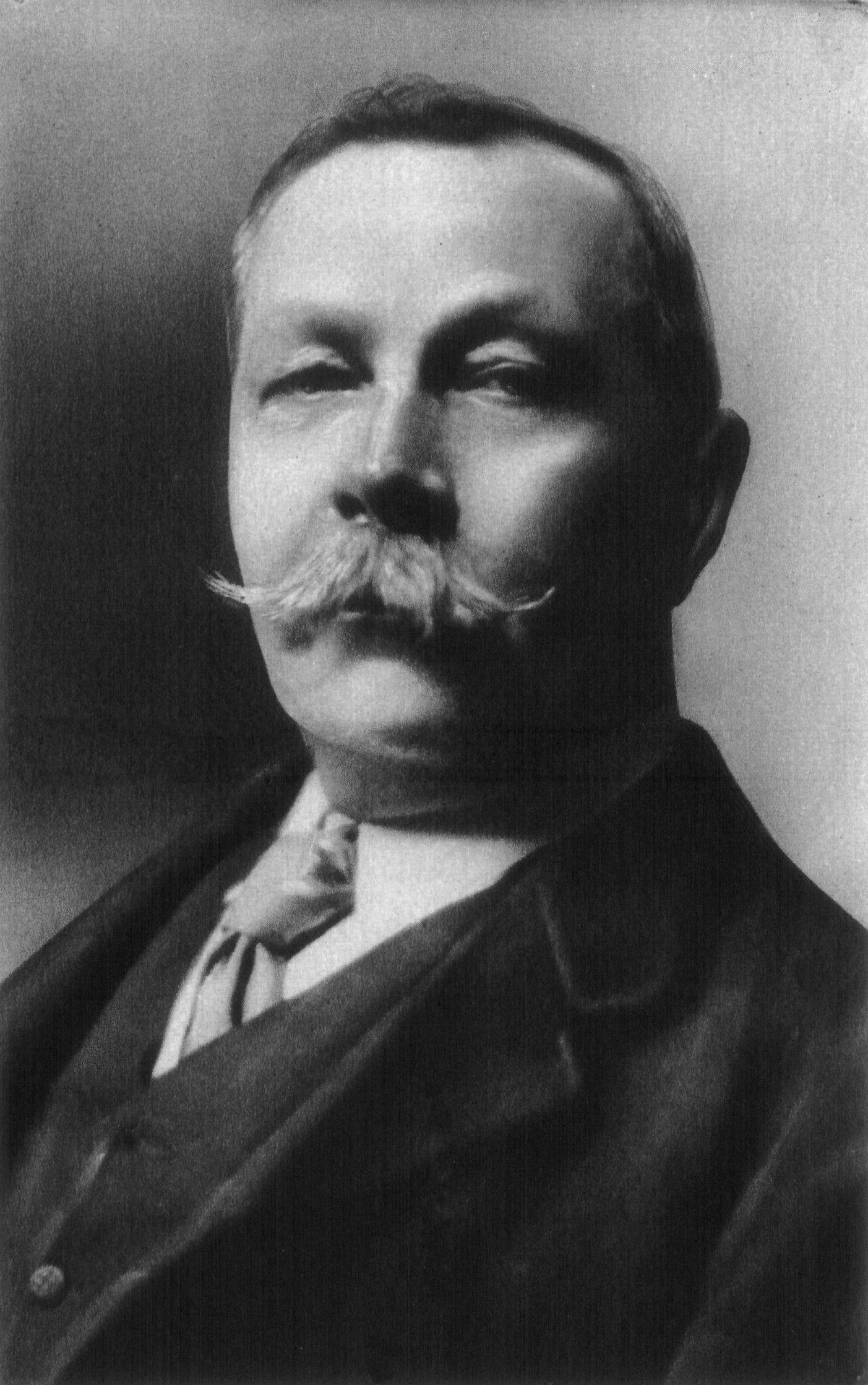
Sir Arthur Ignatius
Conan Doyle KStJ, DL (22 May 1859 – 7 July 1930) was a Scottish physician and
writer who is most noted for his fictional stories about the detective Sherlock
Holmes, which are generally considered milestones in the field of crime
fiction. He is also known for writing the fictional adventures of a second
character he invented, Professor Challenger, and for popularising the mystery
of the Mary Celeste. He was a prolific writer whose other works include fantasy
and science fiction stories, plays, romances, poetry, non-fiction, and
historical novels.
A professional is a
member of a profession. The term also describes the standards of education and
training that prepare members of the profession with the particular knowledge
and skills necessary to perform the role of that profession. In addition, most professionals
are subject to strict codes of conduct enshrining rigorous ethical and moral
obligations. Professional standards of practice and ethics for a particular
field are typically agreed upon and maintained through widely recognized
professional associations. Some definitions of "professional" limit
this term to those professions that serve some important aspect of public
interest and the general good of society.
An amateur (French
amateur "lover of", from Old French and ultimately from Latin
amatorem nom. amator, "lover") is generally considered a person
attached to a particular pursuit, study, or science in a non-professional or
unpaid manner. Amateurs often have little or no formal training in their
pursuits, and many are autodidacts (self-taught).

Crime/ murder/
reasoning
In ordinary language,
the term crime denotes an unlawful act punishable by a state. The term crime
does not, in modern criminal law, have any simple and universally accepted
definition, though statutory definitions have been provided for certain
purposes. The most popular view is that crime is a category created by law
(i.e. something is a crime if applicable law says that it is). One proposed
definition is that a crime, also called an offence or a criminal offence, is an
act harmful not only to some individual, but also to the community or the state
(a public wrong). Such acts are forbidden and punishable by law.
Murder is the unlawful
killing, with malice aforethought, of another human, and generally this
premeditated state of mind distinguishes murder from other forms of unlawful
homicide (such as manslaughter).
Reason is the capacity
for consciously making sense of things, applying logic, for establishing and
verifying facts, and changing or justifying practices, institutions, and
beliefs based on new or existing information. It is closely associated with
such characteristically human activities as philosophy, science, language,
mathematics, and art, and is normally considered to be a definitive characteristic
of human nature. The concept of reason is sometimes referred to as rationality
and sometimes as discursive reason, in opposition to intuitive reason.
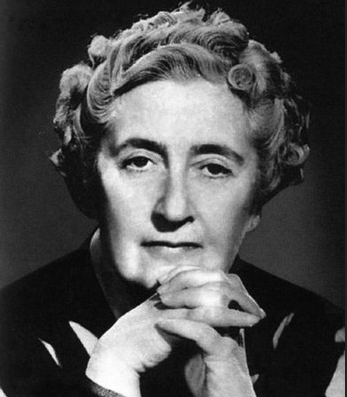
Dame Agatha Mary
Clarissa Christie, DBE (born Miller; 15 September 1890 – 12 January 1976) was
an English crime novelist, short story writer, and playwright. She also wrote
six romances under the name Mary Westmacott, but she is best known for the 66
detective novels and 14 short story collections she wrote under her own name,
most of which revolve around the investigations of such characters as Hercule
Poirot, Miss Jane Marple and Tommy and Tuppence. She also wrote the world's
longest-running play, The Mousetrap.

The romance novel or
romantic novel is a literary genre. Novels of this type of genre fiction place
their primary focus on the relationship and romantic love between two people,
and must have an "emotionally satisfying and optimistic ending."
There are many subgenres of the romance novel including fantasy, historical,
science fiction and paranormal.
The sentimental novel
or the novel of sensibility is an 18th-century literary genre which celebrates
the emotional and intellectual concepts of sentiment, sentimentalism, and
sensibility. Sentimentalism, which is to be distinguished from sensibility, was
a fashion in both poetry and prose fiction beginning in the eighteenth century
in reaction to the rationalism of the Augustan Age.
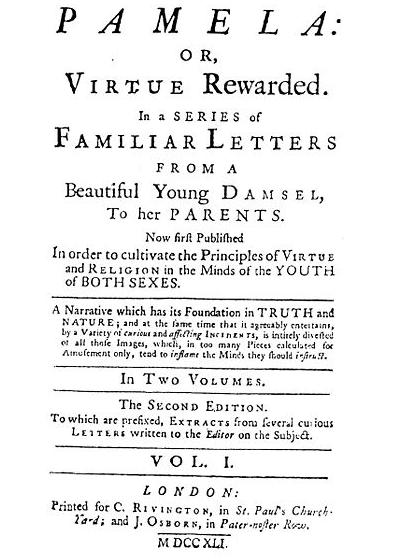
Pamela:
British novel
Pamela, or Virtue
Rewarded is an epistolary novel by Samuel Richardson, first published in 1740.
It tells the story of a beautiful 15-year old maidservant named Pamela Andrews,
whose country landowner master, Mr. B, makes unwanted advances towards her
after the death of his mother, whose maid Pamela had been since age 12. Mr. B is
infatuated with her, first by her looks and then her innocence and
intelligence, but his high rank hinders him from proposing marriage. He abducts
her, locks her up in one of his estates, and attempts to seduce and rape her.
She rejects him continually, but starts to realise that she is falling in love
with him. He intercepts her letters to her parents; reading them, he becomes
even more enamored by her innocence, intelligence, and continuous escape
attempts. Her virtue is eventually rewarded when he sincerely proposes an
equitable marriage to her. In the novel's second part, Pamela attempts to build
a successful relationship with him and to acclimatise to upper class society.
The story, a best-seller of its time, was very widely read but criticised for its
perceived licentiousness.

Samuel Richardson (19
August 1689 – 4 July 1761) was an 18th-century English writer and printer. He
is best known for his three epistolary novels: Pamela: Or, Virtue Rewarded
(1740), Clarissa: Or the History of a Young Lady (1748) and The History of Sir
Charles Grandison (1753). Richardson was an established printer and publisher
for most of his life and printed almost 500 different works, with journals and
magazines.

literary
representation.

Miguel de Cervantes
Saavedra (Spanish: [miˈɣel de θerˈβantes saaˈβeðɾa]; 29 September 1547
(assumed) – 22 April 1616) was a Spanish novelist, poet, and playwright.
His magnum opus, Don
Quixote, considered to be the first modern European novel, is a classic of
Western literature, and is regarded amongst the best works of fiction ever
written. His influence on the Spanish language has been so great that the language
is often called la lengua de Cervantes ("the language of Cervantes").
He was dubbed El Príncipe de los Ingenios ("The Prince of Wits").

Sancho Panza [ˈsantʃo
ˈpanθa] is a fictional character in the novel Don Quixote written by Spanish
author Don Miguel de Cervantes Saavedra in 1605. Sancho acts as squire to Don
Quixote, and provides comments throughout the novel, known as sanchismos, that
are a combination of broad humour, ironic Spanish proverbs, and earthy wit.
"Panza" in Spanish means "belly" (cf. English
"paunch," Italian "pancia").
Mock-heroic, mock-epic
or heroi-comic works are typically satires or parodies that mock common
Classical stereotypes of heroes and heroic literature. Typically, mock-heroic
works either put a fool in the role of the hero or exaggerate the heroic
qualities to such a point that they become absurd.
Mock at/ laugh at/
make fun of me
Omni-: all
-scient: view
Point of view
Perspective: to look
A narrative (or play)
is any account of connected events, presented to a reader or listener in a
sequence of written or spoken words, or in a sequence of (moving) pictures.
A character (or
fictional character) is a person in a narrative work of arts (such as a novel,
play, television series or film). Derived from the ancient Greek word
kharaktêr, the English word dates from the Restoration, although it became
widely used after its appearance in Tom Jones in 1749. From this, the sense of
"a part played by an actor" developed. Character, particularly when
enacted by an actor in the theatre or cinema, involves "the illusion of
being a human person." In literature, characters guide readers through
their stories, helping them to understand plots and ponder themes. Since the
end of the 18th century, the phrase "in character" has been used to
describe an effective impersonation by an actor. Since the 19th century, the
art of creating characters, as practised by actors or writers, has been called
characterisation.

The Sun Also Rises is
a 1926 novel written by American author Ernest Hemingway about a group of
American and British expatriates who travel from Paris to the Festival of San
Fermín in Pamplona to watch the running of the bulls and the bullfights. An
early and enduring modernist novel, it received mixed reviews upon publication.
Hemingway biographer Jeffrey Meyers writes that it is "recognized as Hemingway's
greatest work", and Hemingway scholar Linda Wagner-Martin calls it his
most important novel. The novel was published in the United States in October
1926 by the publishing house Scribner's. A year later, the London publishing
house Jonathan Cape published the novel with the title of Fiesta. Since then it
has been continuously in print.
I could picture it. I have
a habit of imagining.
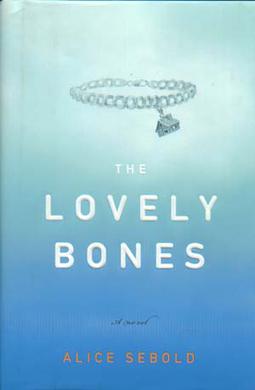
The Lovely Bones is a
2002 novel by Alice Sebold. It is the story of a teenage girl who, after being
raped and murdered, watches from her personal Heaven as her family and friends
struggle to move on with their lives while she comes to terms with her own
death. The novel received much critical praise and became an instant
bestseller. A film adaptation of the novel, directed by Peter Jackson who
personally purchased the rights, was released in North American theaters on
January 15, 2010, and in the UK on February 15, 2010.

David Herbert Lawrence
(11 September 1885 – 2 March 1930) was an English novelist, poet, playwright,
essayist, literary critic and painter who published as D. H. Lawrence. His
collected works, among other things, represent an extended reflection upon the
dehumanising effects of modernity and industrialisation. In them, some of the
issues Lawrence explores are emotional health, vitality, spontaneity and instinct.
By D. H. (David
Herbert) Lawrence
Softly, in the dusk, a
woman is singing to me;
Taking me back down
the vista of years, till I see
A child sitting under
the piano, in the boom of the tingling strings
And pressing the
small, poised feet of a mother who smiles as she sings.
In spite of myself,
the insidious mastery of song
Betrays me back, till
the heart of me weeps to belong
To the old Sunday
evenings at home, with winter outside
And hymns in the cosy
parlour, the tinkling piano our guide.
So now it is vain for
the singer to burst into clamour
With the great black
piano appassionato. The glamour
Of childish days is
upon me, my manhood is cast
Down in the flood of
remembrance, I weep like a child for the past.

Lady Chatterley's
Lover is a novel by D. H. Lawrence, first published in 1928. The first edition
was printed privately in Florence, Italy, with assistance from Pino Orioli; an
unexpurgated edition could not be published openly in the United Kingdom until
1960. (A private edition was issued by Inky Stephensen's Mandrake Press in
1929.) The book soon became notorious for its story of the physical (and
emotional) relationship between a working-class man and an upper-class woman,
its explicit descriptions of sex, and its use of then-unprintable words.
Tedious: boring
and too slow or long
Hideous: very ugly
or disgusting

Nottingham (Listeni/ˈnɒtɪŋəm/
NOT-ing-əm) is a city and unitary authority area in the East Midlands of
England, and County town of the ceremonial county of Nottinghamshire.
Nottingham is famed
for its links to the legend of Robin Hood and, during the Industrial
Revolution, obtained worldwide recognition for its lace-making, bicycle and
tobacco industries. Nottingham's origins are traceable back to 600 AD, however,
it was only granted its city charter in 1897, as part of the Diamond Jubilee
celebrations of Queen Victoria, and has since been officially titled the City
of Nottingham.


Stonehenge is a
prehistoric monument in Wiltshire, England, about 2 miles (3.2 km) west of
Amesbury and 8 miles (13 km) north of Salisbury. One of the most famous sites
in the world, Stonehenge is the remains of a ring of standing stones set within
earthworks. It is in the middle of the most dense complex of Neolithic and
Bronze Age monuments in England, including several hundred burial mounds.
A shire is a
traditional term for a division of land, found in the United Kingdom and
Australia. In some rural parts of Australia, a shire is a local government
area, however it is not synonymous with "county", which is, in Australia,
a lands administrative division. Individually, or as a suffix in Scotland and
in the far northeast of England, the word is pronounced /ˈʃaɪər/. As a suffix
in an English or Welsh place name, it is in most regions pronounced /ʃɜr/, or
sometimes /ʃɪər/.
In Britain,
"shire" is the original term for what is usually known now as a
county; the word county having been introduced at the Norman Conquest of
England. The two are synonymous. Although in modern British usage counties are
referred to as "shires" mainly in poetic contexts, terms such as
Shire Hall remain common. Shire also remains a common part of many county
names.

The White Peacock is a
novel by D. H. Lawrence published in 1911. Lawrence started the novel in 1906
and then rewrote it three times. The early versions had the working title of
Laetitia.
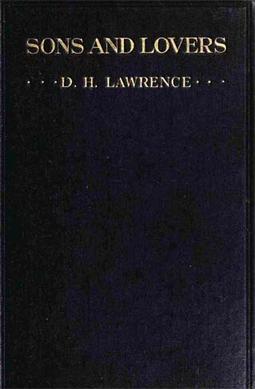
Sons and Lovers is a
1913 novel by the English writer D. H. Lawrence. The Modern Library placed it
ninth on their list of the 100 best novels of the 20th century. While the novel
initially incited a lukewarm critical reception, along with allegations of
obscenity, it is today regarded as a masterpiece by many critics and is often
regarded as Lawrence's finest achievement.
"The
Rocking-Horse Winner" is a short story by D. H. Lawrence. It was first
published in July 1926, in Harper's Bazaar and subsequently appeared in the
first volume of Lawrence's collected short stories. It was made into a
full-length film directed by Anthony Pelissier and starring John Howard Davies,
Valerie Hobson and John Mills; the film was released in the United Kingdom in
1949 and in 1950 in the United States.
Haunting message: lack
Erotic: love can only
happen with the element of the body, not the mind
Comments
Post a Comment