Week 14 Willa Cather’s “Paul‘s Case”
The Chronicles of
Narnia is a series of seven high fantasy novels by author C.S. Lewis. It is
considered a classic of children's literature and is the author's best-known
work, having sold over 100 million copies in 47 languages. Written by Lewis between
1949 and 1954, illustrated by Pauline Baynes and originally published in London
between October 1950 and March 1956, The Chronicles of Narnia has been adapted
several times, complete or in part, for radio, television, the stage, and film.

Sir William Gerald
Golding Kt., CBE (19 September 1911 – 19 June 1993) was an English novelist,
playwright, and poet who won a Nobel Prize in Literature, and is best known for
his novel Lord of the Flies. He was also awarded the Booker Prize for
literature in 1980 for his novel Rites of Passage, the first book in what
became his sea trilogy, To the Ends of the Earth.
Golding was knighted
by Elizabeth II in 1988. He was a fellow of the Royal Society of Literature. In
2008, The Times ranked Golding third on their list of "The 50 greatest
British writers since 1945".

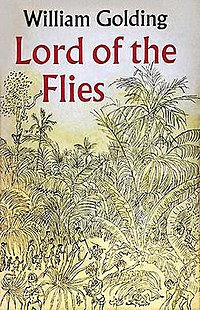
Lord of the Flies is a
1954 dystopian novel by Nobel Prize-winning English author William Golding
about a group of British boys stuck on an uninhabited island who try to govern
themselves with disastrous results. Its stances on the already controversial
subjects of human nature and individual welfare versus the common good earned
it position 68 on the American Library Association’s list of the 100 most
frequently challenged books of 1990–1999. The novel is a reaction to the youth
novel The Coral Island by R. M. Ballantyne.
Published in 1954,
Lord of the Flies was Golding’s first novel. Although it was not a great
success at the time—selling fewer than 3,000 copies in the United States during
1955 before going out of print—it soon went on to become a best-seller, and by
the early 1960s was required reading in many schools and colleges. It has been
adapted to film twice in English, in 1963 by Peter Brook and 1990 by Harry Hook,
and once in Filipino (1976).
In 2005 the novel was
chosen by TIME magazine as one of the 100 best English-language novels from
1923 to 2005. It was awarded a place on both lists of Modern Library 100 Best
Novels, reaching number 41 on the editor's list, and 25 on the reader's list.
In 2003, the novel was listed at number 70 on the BBC's survey The Big Read.
A dystopia (from the
Greek δυσ- and τόπος, alternatively, cacotopia, kakotopia, cackotopia, or
anti-utopia) is a community or society that is in some important way
undesirable or frightening. It is the opposite of a utopia. Such societies
appear in many artistic works, particularly in stories set in a future.
Dystopias are often characterized by dehumanization, totalitarian governments,
environmental disaster, or other characteristics associated with a cataclysmic
decline in society. Dystopian societies appear in many sub-genres of fiction
and are often used to draw attention to real-world issues regarding society,
environment, politics, economics, religion, psychology, ethics, science, and/or
technology, which if unaddressed could potentially lead to such a dystopia-like
condition.
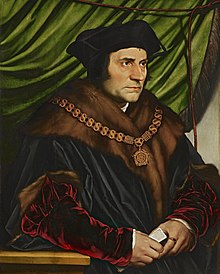
Sir Thomas More (/ˈmɔr/;
7 February 1478 – 6 July 1535), known to Roman Catholics as Saint Thomas More,
was an English lawyer, social philosopher, author, statesman and noted
Renaissance humanist. He was an important councillor to Henry VIII and Lord
Chancellor from October 1529 to 16 May 1532. More opposed the Protestant
Reformation, in particular the theology of Martin Luther and William Tyndale,
whose books he burned and whose followers he persecuted. More also wrote
Utopia, published in 1516, about the political system of an ideal and imaginary
island nation. More later opposed the King's separation from the Catholic
Church and refused to accept him as Supreme Head of the Church of England
because it disparaged papal authority and Henry's marriage to Catherine of
Aragon. Tried for treason, More was convicted on perjured testimony and
beheaded.
Pope Pius XI canonised
More in 1935 as a martyr of the schism that separated the Church of England
from Rome; Pope John Paul II in 2000 declared More the "heavenly Patron of
Statesmen and Politicians". Since 1980, the Church of England has
remembered More liturgically as a Reformation martyr. In 2002, he was placed at
number 37 in the BBC's poll of the 100 Greatest Britons
He opposed the
Protestant Reformation.
He wrote Utopia.

Neverland is a
fictional place featured in the works of J. M. Barrie and those based on them.
It is the dwelling place of Peter Pan, Tinker Bell, the Lost Boys and others.
Although not all people in Neverland cease to age, its best known resident
famously refused to grow up, and it is often used as a metaphor for eternal
childhood (and childishness), immortality, and escapism. It was first
introduced as "the Never Never Land" in the theatre play Peter Pan,
or The Boy Who Wouldn't Grow Up by Scottish writer J. M. Barrie, first staged
in 1904.
In his 1911
novelization Peter and Wendy, Barrie referred to "the Neverland", and
its many variations "the Neverlands". In the earliest drafts of
Barrie's play, the island was called "Peter's Never Never Never
Land", a name possibly influenced by "the Never Never", a
contemporary term for outback Australia. In the 1928 published version of the
script, it was shortened to "the Never Land". Neverland has been
featured prominently in subsequent works, either adapting Barrie's works or
expanding upon them. These Neverlands sometimes vary in nature from the
original.

A frame story (also
frame tale, frame narrative, etc.) is a literary technique that sometimes
serves as a companion piece to a story within a story, whereby an introductory
or main narrative is presented, at least in part, for the purpose of setting
the stage either for a more emphasized second narrative or for a set of shorter
stories. The frame story leads readers from a first story into another, smaller
one (or several ones) within it.

Escapism is mental
diversion by means of entertainment or recreation, as an "escape"
from the perceived unpleasant or banal aspects of daily life. It can also be
used as a term to define the actions people take to help relieve persisting
feelings of depression or general sadness.
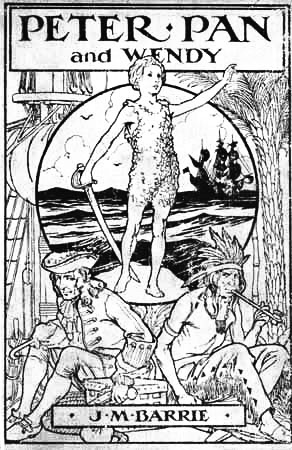
Peter Pan is a
character created by Scottish novelist and playwright J. M. Barrie. A mischievous
boy who can fly and never grows up, Peter Pan spends his never-ending childhood
adventuring on the small island of Neverland as the leader of his gang, the
Lost Boys, interacting with mermaids, Native Americans, fairies, pirates, and
occasionally ordinary children from the world outside of Neverland. In addition
to two distinct works by Barrie, the character has been featured in a variety
of media and merchandise, both adapting and expanding on Barrie's works.
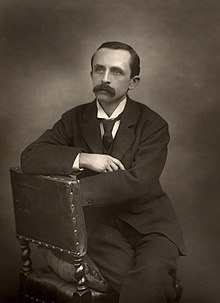
Sir James Matthew
Barrie, 1st Baronet, OM (9 May 1860 – 19 June 1937) was a Scottish author and
dramatist, best remembered today as the creator of Peter Pan. The child of a
family of small-town weavers, he was educated in Scotland. He moved to London,
where he developed a career as a novelist and playwright. There he met the
Llewelyn Davies boys who inspired him in writing about a baby boy who has
magical adventures in Kensington Gardens (included in The Little White Bird),
then to write Peter Pan, or The Boy Who Wouldn't Grow Up, a "fairy play"
about this ageless boy and an ordinary girl named Wendy who have adventures in
the fantasy setting of Neverland. This play quickly overshadowed his previous
work and although he continued to write successfully, it became his best-known
work, credited with popularising the name Wendy, which was very uncommon
previously. Barrie unofficially adopted the Davies boys following the deaths of
their parents.
Barrie was made a
baronet by George V in 1913, and a member of the Order of Merit in 1922. Before
his death, he gave the rights to the Peter Pan works to London's Great Ormond
Street Hospital, which continues to benefit from them.

Tinker Bell (often
misspelled as Tinkerbell, also referred to as Tink for short), is a fictional
character from J. M. Barrie's 1904 play Peter Pan and its 1911 novelization
Peter and Wendy. She has appeared in multiple film and television adaptations
of the Peter Pan stories, in particular the 1953 animated Walt Disney picture
Peter Pan. She also appears in the official sequel Peter Pan in Scarlet by
Geraldine McCaughrean and commissioned by Great Ormond St Hospital as well as
the "Peter and the Starcatchers" book series by Ridley Pearson and
Dave Barry. At first only a supporting character described by her creator as "a
common fairy", her animated incarnation was a hit and has since become a
widely recognized unofficial mascot of The Walt Disney Company, and the
centerpiece of its Disney Fairies media franchise including the direct-to-DVD
film series Tinker Bell. In her animated form she leaves a trail of twinkling
pixie dust.
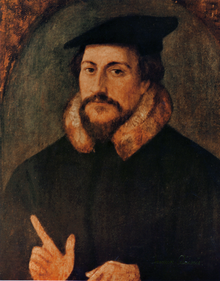
John Calvin (French:
Jean Calvin French pronunciation: [ʒɑ̃ kalvɛ̃], born Jehan Cauvin: 10 July
1509 – 27 May 1564) was an influential French theologian and pastor during the
Protestant Reformation. He was a principal figure in the development of the
system of Christian theology later called Calvinism. Originally trained as a
humanist lawyer, he broke from the Roman Catholic Church around 1530. After
religious tensions provoked a violent uprising against Protestants in France,
Calvin fled to Basel, Switzerland, where he published the first edition of his
seminal work Institutes of the Christian Religion in 1536.

Plato (/ˈpleɪtoʊ/; Greek:
Πλάτων, Plátōn, "broad"; 428/427 or 424/423 BC[a] – 348/347 BC) was a
philosopher, as well as mathematician, in Classical Greece and an influential
figure in philosophy, central in Western philosophy. He was Socrates' student,
and founded the Academy in Athens, the first institution of higher learning in
the Western world. Along with Socrates and his most-famous student, Aristotle,
Plato helped to lay the foundations of Western philosophy and science. Alfred
North Whitehead once noted: "the safest general characterization of the
European philosophical tradition is that it consists of a series of footnotes
to Plato."
Plato's philosophical
ability is evident in his Socratic dialogues; thirty-six dialogues and thirteen
letters have been ascribed to him, although 15–18 of these are contested.
Plato's dialogues have been used to teach a range of subjects, including
philosophy, logic, ethics, rhetoric, religion and mathematics. His other
notable and influential work is the Theory of Forms which began a unique
perspective on abstract objects, and lead to a school of thought called
Platonism. Plato's writings have been published in several fashions; this has
led to several conventions regarding the naming and referencing of Plato's
texts.
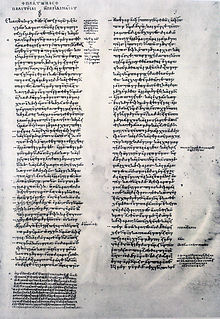
The Republic (Greek:
Πολιτεία, Politeia) is a Socratic dialogue, written by Plato around 380 BC,
concerning the definition of justice (δικαιοσύνη), the order and character of
the just city-state and the just man, reason by which ancient readers used the
name On Justice as an alternative title (not to be confused with the spurious
dialogue also titled On Justice). The dramatic date of the dialogue has been
much debated and though it must take place some time during the Peloponnesian
War, "there would be jarring anachronisms if any of the candidate specific
dates between 432 and 404 were assigned". It is Plato's best-known work
and has proven to be one of the most intellectually and historically
influential works of philosophy and political theory. In it, Socrates along
with various Athenians and foreigners discuss the meaning of justice and
examine whether or not the just man is happier than the unjust man by
considering a series of different cities coming into existence "in
speech", culminating in a city (Kallipolis) ruled by philosopher-kings;
and by examining the nature of existing regimes. The participants also discuss
the theory of forms, the immortality of the soul, and the roles of the philosopher
and of poetry in society.
Socratic dialogue
(Ancient Greek: Σωκρατικὸς λόγος) is a genre of prose literary works developed
in Greece at the turn of the fourth century BCE, preserved today in the
dialogues of Plato and the Socratic works of Xenophon. Characters discuss moral
and philosophical problems, illustrating a version of the Socratic method. The
dialogues are either dramatic or narrative, and Socrates is often the main
character.

The Peloponnesian War
(431–404 BC) was an ancient Greek war fought by Athens and its empire against
the Peloponnesian League led by Sparta. Historians have traditionally divided
the war into three phases. In the first phase, the Archidamian War, Sparta
launched repeated invasions of Attica, while Athens took advantage of its naval
supremacy to raid the coast of the Peloponnese attempting to suppress signs of
unrest in its empire. This period of the war was concluded in 421 BC, with the
signing of the Peace of Nicias. That treaty, however, was soon undermined by
renewed fighting in the Peloponnese. In 415 BC, Athens dispatched a massive
expeditionary force to attack Syracuse in Sicily; the attack failed
disastrously, with the destruction of the entire force, in 413 BC. This ushered
in the final phase of the war, generally referred to either as the Decelean
War, or the Ionian War. In this phase, Sparta, now receiving support from
Persia, supported rebellions in Athens' subject states in the Aegean Sea and
Ionia, undermining Athens' empire, and, eventually, depriving the city of naval
supremacy. The destruction of Athens' fleet at Aegospotami effectively ended
the war, and Athens surrendered in the following year.
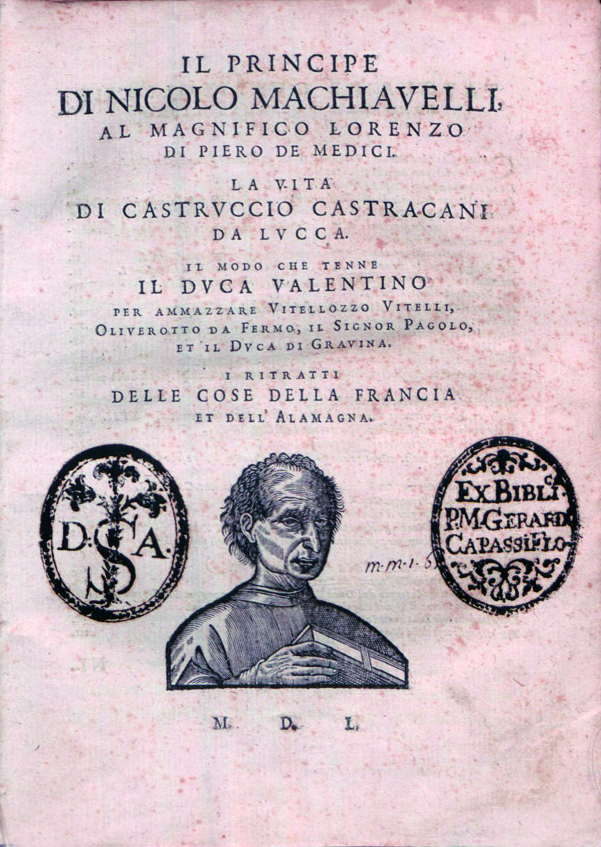
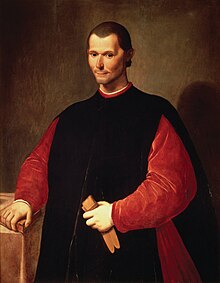
The Prince (Italian:
Il Principe [il ˈprin.tʃi.pe]) is a 16th-century political treatise by the
Italian diplomat and political theorist Niccolò Machiavelli. From
correspondence a version appears to have been distributed in 1513, using a
Latin title, De Principatibus (About Principalities). However, the printed
version was not published until 1532, five years after Machiavelli's death.
This was done with the permission of the Medici pope Clement VII, but
"long before then, in fact since the first appearance of the Prince in
manuscript, controversy had swirled about his writings".
As cunning as fox
As vicious as a lion
Vice vs. Virtue
Machiavellianism is,
according to the Oxford English Dictionary, "the employment of cunning and
duplicity in statecraft or in general conduct", deriving from the Italian
Renaissance diplomat and writer Niccolò Machiavelli, who wrote Il Principe (The
Prince), among other works. The word has a similar use in modern psychology
where it describes one of the dark triad personalities, characterised by a
duplicitous interpersonal style associated with cynical beliefs and pragmatic
morality. "Machiavellian" as a word became very popular in the late
16th century in English, though "Machiavellianism" itself is first
cited by the Oxford English Dictionary from 1626.
Comments
Post a Comment