Week 13 Continue Oates
The Deep South is a
descriptive category of the cultural and geographic subregions in the Southern
United States. Historically, it is differentiated from the "Upper
South" as being the states most dependent on plantation type agriculture
during the pre–Civil War period. The Deep South was also commonly referred to
as the Lower South or the Cotton States. People of English ancestry
traditionally predominate in every part of the Deep South except for southern
Louisiana. As late as the 1980 census, people of English ancestry formed the
largest single self-reported ancestry group in every single Southern State by a
large margin.
Today, the Deep South
is usually delineated as being those states and areas where things most often
thought of as "Southern" exist in their most concentrated form.

Gerald Rudolph
"Jerry" Ford, Jr. (born Leslie Lynch King, Jr.; July 14, 1913 –
December 26, 2006) was the 38th President of the United States, serving from
1974 to 1977, and prior to this, was the 40th Vice President of the United
States serving from 1973 to 1974. He was the first person appointed to the Vice
Presidency under the terms of the 25th Amendment, after Spiro Agnew resigned.
When he became president upon Richard Nixon's resignation on August 9, 1974, he
became the first and to date only person to have served as both Vice President
and President of the United States without being elected by the Electoral
College. Before ascending to the Vice Presidency, Ford served nearly 25 years
as the Representative from Michigan's 5th congressional district, eight of them
as the Republican Minority Leader.

Omaha /ˈoʊməhɑː/ is
the largest city in the state of Nebraska, United States, and is the county
seat of Douglas County. It is located in the Midwestern United States on the
Missouri River, about 10 miles (16 km) north of the mouth of the Platte River.
Omaha is the anchor of the Omaha-Council Bluffs metropolitan area, which
includes Council Bluffs, Iowa, across the Missouri River from Omaha.

Up in the Air is a
2009 American comedy-drama film directed by Jason Reitman and co-written by
Reitman and Sheldon Turner. It is a film adaptation of the 2001 novel of the
same name, written by Walter Kirn. The story is centered on a corporate
"downsizer" Ryan Bingham (George Clooney) and his travels. The film
follows his isolated life and philosophies and the people he meets along the
way. Filming was primarily in St. Louis, Missouri, which substituted for a
number of other cities. Several scenes were filmed in Detroit, Michigan; Omaha,
Nebraska; Las Vegas, Nevada; and Miami, Florida.

Henry James, OM (15
April 1843 – 28 February 1916) was an Anglo-American writer who spent the bulk
of his career in Britain. He is regarded as one of the key figures of
19th-century literary realism. He was the son of Henry James, Sr. and the
brother of philosopher and psychologist William James and diarist Alice James.

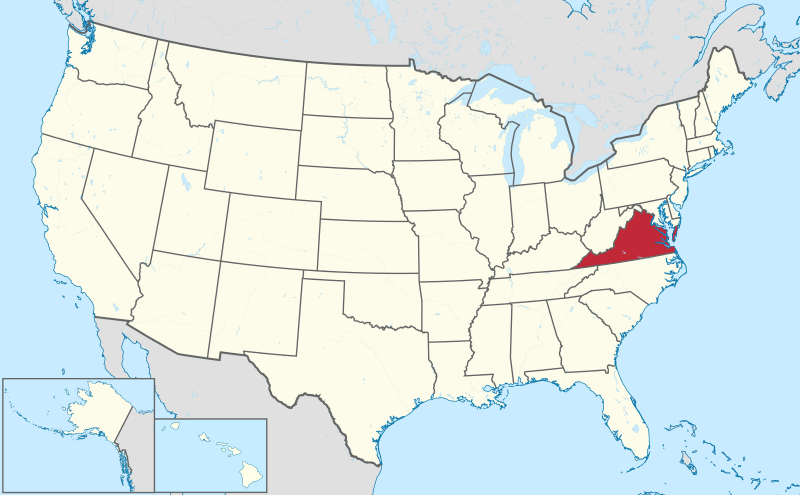
Virginia (/vərˈdʒɪnjə/),
officially the Commonwealth of Virginia, is a U.S. state located in the South
Atlantic region of the United States. Virginia is nicknamed the "Old
Dominion" due to its status as a former dominion of the English Crown, and
"Mother of Presidents" due to the most U.S. presidents having been
born there. The geography and climate of the Commonwealth are shaped by the
Blue Ridge Mountains and the Chesapeake Bay, which provide habitat for much of
its flora and fauna. The capital of the Commonwealth is Richmond; Virginia
Beach is the most populous city, and Fairfax County is the most populous
political subdivision. The Commonwealth's estimated population as of 2013 is
over 8.2 million.
Nebraska /nəˈbræskə/
is a state that lies in both the Great Plains and the Midwestern United States.
Its state capital is Lincoln. Its largest city is Omaha, which is on the
Missouri River.
The state is crossed
by many historic trails, but it was the California Gold Rush that first brought
large numbers of non-indigenous settlers to the area. Nebraska became a state
in 1867.
There are wide
variations between winter and summer temperatures, and violent thunderstorms
and tornadoes are common. The state is characterized by treeless prairie, ideal
for cattle-grazing, and it is a major producer of beef, as well as pork, corn,
and soybeans.
Ethnically, the
largest group of Nebraskans are German American. The state also has the largest
per capita population of Czech Americans among U.S. states.


O Pioneers! is a 1913
novel by American author Willa Cather, written while she was living in New
York. It is the first novel of her Great Plains trilogy, followed by The Song
of the Lark (1915) and My Ántonia (1918).

My Ántonia (pronounced
with the accent on the first syllable of "Ántonia")[1] is a novel
published in 1918 by American writer Willa Cather, considered one of her best
works. It is the final book of her "prairie trilogy" of novels,
preceded by O Pioneers! and The Song of the Lark.

Willa Sibert Cather
(/ˈkæðər/; December 7, 1873 – April 24, 1947) was an American author who
achieved recognition for her novels of frontier life on the Great Plains, in
works such as O Pioneers!, My Ántonia, and The Song of the Lark. In 1923 she
was awarded the Pulitzer Prize for One of Ours (1922), a novel set during World
War I. Cather grew up in Nebraska and graduated from the University of
Nebraska. She lived and worked in Pittsburgh for ten years. At the age of 33
she moved to New York, where she lived for the rest of her life.

Good luck charm is a
charm that is believed to bring good luck. An example of this is a blessing
that a minister or a priest gives at the end of a ceremony. Later on, people
assumed that spoken words were temporary whereas a solid object is more
permanent. Objects that have extraordinary significance such as the splinter
believed to be from the cross of Jesus Christ were substituted for the original
spoken or sung charms.
Almost any object can
be used as a charm. Coins and buttons are good examples. Small objects that are
given to you make very good lucky charms. It is because of the favorable
associations they make. Several souvenir shops have a range of tiny items that
may be used as good luck charms. Good luck charms are usually worn on the body
although there are exceptions.

Throw up
Pick at her
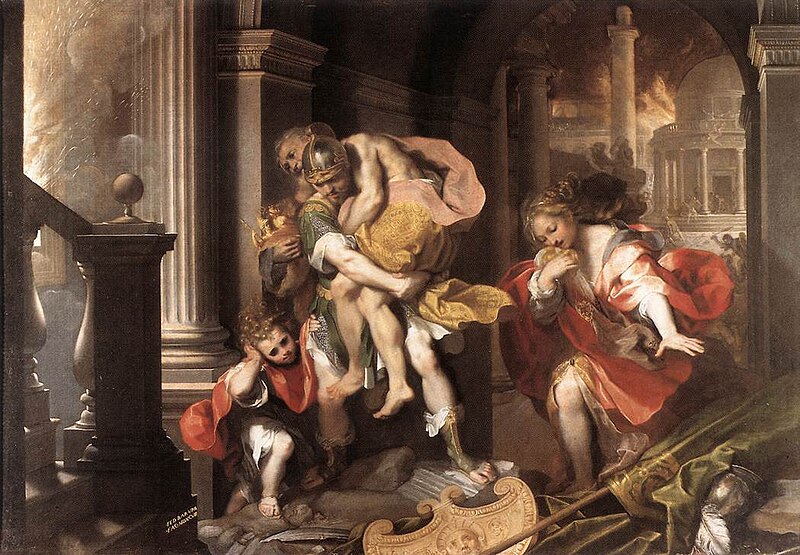
The Aeneid (/əˈniːɪd/;
Latin: Aeneis [ajˈneːis]—from the Greek, genitive case Aeneidos) is a Latin
epic poem, written by Virgil between 29 and 19 BC, that tells the legendary
story of Aeneas, a Trojan who travelled to Italy, where he became the ancestor
of the Romans. It is composed of 9,896 lines in dactylic hexameter. The first
six of the poem's twelve books tell the story of Aeneas's wanderings from Troy
to Italy, and the poem's second half tells of the Trojans' ultimately
victorious war upon the Latins, under whose name Aeneas and his Trojan
followers are destined to be subsumed.
A decrepit car is a
car that is often old and damaged and is in a barely functional state. Numerous
slang terms are used to describe such cars, which vary by country and region,
including hoopty, jalopy, clunker, lemon, banger, bomb, beater, rust bucket,
voodoo, wreck, or rattletrap.

Slit her eyes
Shaggy shabby black
hair
Tenderness stab in
Macbeth
Attendant
Chunky meat
Vanity
Disagreeable-looking
Sour expression
Sickly fretful ugly
Toddling
Novel of formation
Coming of age
Martha Colin
Buildungsroman
If you’re not born
one, educate yourself.
Decrepit carà old and damaged
De-: down, away from
Wreck rattle trap
"Where Are You
Going, Where Have You Been?" is a frequently anthologized short story
written by Joyce Carol Oates. The story first appeared in the Fall 1966 edition
of Epoch Magazine. It was inspired by three Tucson, Arizona murders committed
by Charles Schmid, which were profiled in Life magazine in an article written
by Don Moser on March 4, 1966. Oates said that she dedicated the story to Bob
Dylan because she was inspired to write it after listening to his song
"It's All Over Now, Baby Blue."
Smooth Talk
Self-absorbed-->keep private to herself
Be at odds with
Dutiful “steady”
Gold convertible
covered with cryptic
Arnold Friend
Ironic pound
Bob Dylan (/ˈdɪlən/;
born Robert Allen Zimmerman, May 24, 1941) is an American musician,
singer-songwriter, artist, and writer. He has been an influential figure in
popular music and culture for more than five decades. Much of his most
celebrated work dates from the 1960s, when he was an informal chronicler and a
seemingly reluctant figurehead of social unrest. A number of Dylan's early
songs, such as "Blowin' in the Wind" and "The Times They Are
a-Changin'", became anthems for the US civil rights and anti-war
movements. Leaving behind his initial base in the culture of the folk music
revival, Dylan's six-minute single "Like a Rolling Stone" radically
altered the parameters of popular music in 1965. His recordings employing
electric instruments attracted denunciation and criticism from others in the
folk movement.
"Blowin' in the
Wind" is a song written by Bob Dylan in 1962 and released on his album The
Freewheelin' Bob Dylan in 1963. Although it has been described as a protest
song, it poses a series of rhetorical questions about peace, war and freedom.
The refrain "The answer, my friend, is blowin' in the wind" has been
described as "impenetrably ambiguous: either the answer is so obvious it
is right in your face, or the answer is as intangible as the wind".
In 1994, the song was
inducted into the Grammy Hall of Fame. In 2004, it was ranked #14 on Rolling
Stone magazine's list of the "500 Greatest Songs of All Time".


Civil and political
rights are a class of rights that protect individuals' freedom from
infringement by governments and private organizations, and ensure one's ability
to participate in the civil and political life of the state without
discrimination or repression.
Civil rights include
the ensuring of peoples' physical and mental integrity, life and safety;
protection from discrimination on grounds such as race, gender, national
origin, colour, sexual orientation, ethnicity, religion, or disability;
and individual rights such as privacy, the freedoms of thought and conscience,
speech and expression, religion, the press, assembly and movement.
Political rights
include natural justice (procedural fairness) in law, such as the rights of the
accused, including the right to a fair trial; due process; the right to seek
redress or a legal remedy; and rights of participation in civil society and
politics such as freedom of association, the right to assemble, the right to
petition, the right of self-defense, and the right to vote.
African Americans,
also referred to as Black Americans or Afro-Americans, are citizens or
residents of the United States who have total or partial antebellum ancestry
from any of the native populations of Sub-Saharan Africa.
African Americans
constitute the second largest racial and ethnic minority in the United States.
Most African Americans are of West and Central African descent and are
descendants of enslaved blacks within the boundaries of the present United States.
However, some immigrants from African, Caribbean, Central American, and South
American nations, and their descendants, may be identified or self-identify
with the term.
African-American
history starts in the 16th century, with Africans forcibly taken to Spanish and
English colonies in North America as slaves. After the United States came into
being, black people continued to be enslaved and treated as inferiors. These
circumstances were changed by Reconstruction, development of the black community,
participation in the great military conflicts of the United States, the
elimination of racial segregation, and the Civil Rights Movement. In 2008,
Barack Obama became the first African American to be elected president of the
United States.
Se-: apart from
Select, elect
The African-American
Civil Rights Movement encompasses social movements in the United States whose
goal was to end racial segregation and discrimination against black Americans
and enforce constitutional voting rights to them. This article covers the phase
of the movement between 1954 and 1968, particularly in the South.
The movement was
characterized by major campaigns of civil resistance. Between 1955 and 1968,
acts of nonviolent protest and civil disobedience produced crisis situations
between activists and government authorities. Federal, state, and local
governments, businesses, and communities often had to respond immediately to
these situations that highlighted the inequities faced by African Americans.
Forms of protest and/or civil disobedience included boycotts such as the
successful Montgomery Bus Boycott (1955–56) in Alabama; "sit-ins"
such as the influential Greensboro sit-ins (1960) in North Carolina; marches,
such as the Selma to Montgomery marches (1965) in Alabama; and a wide range of
other nonviolent activities.

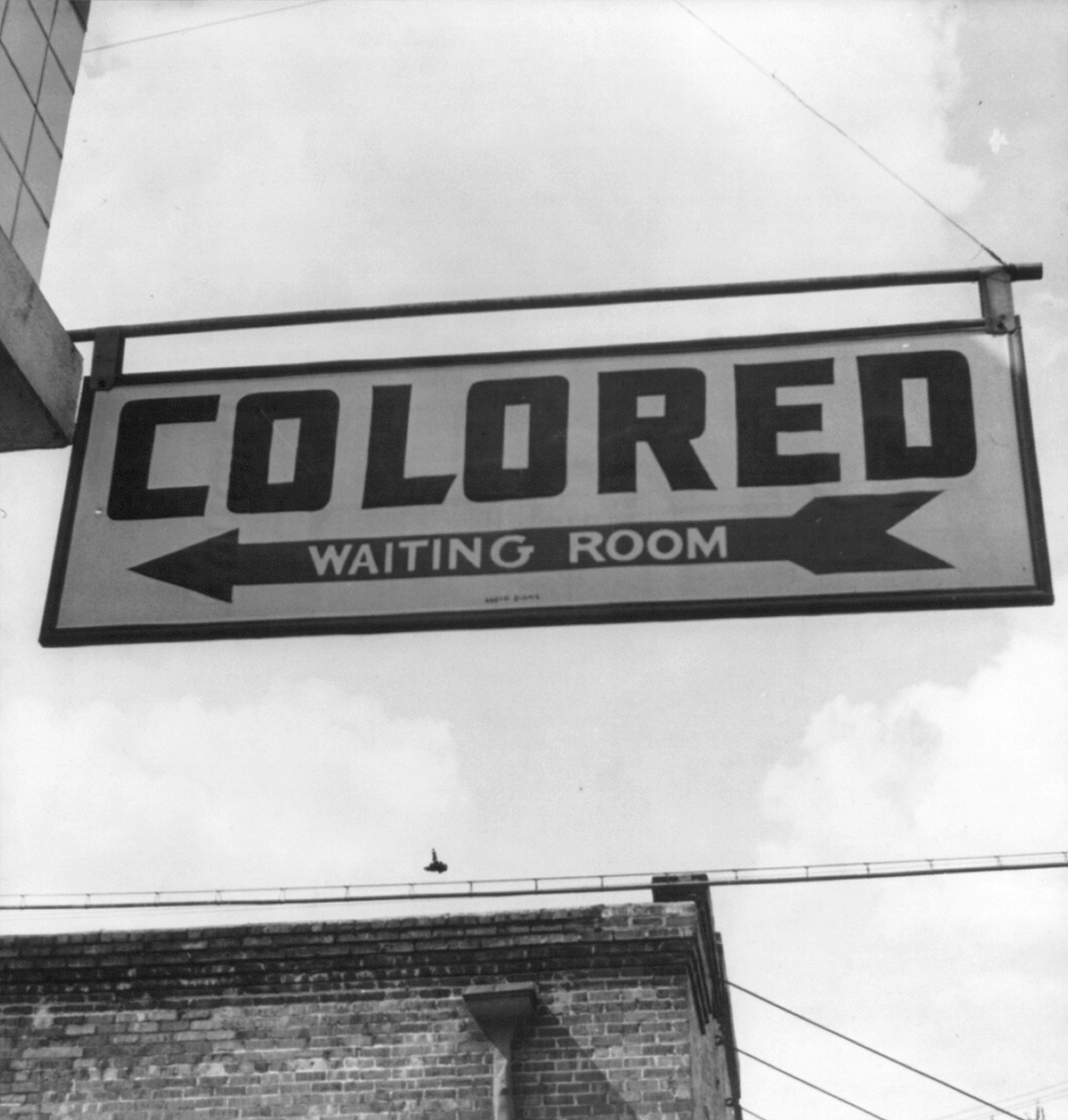
Segregation is
separation of humans into racial groups in daily life. It may apply to
activities such as eating in a restaurant, drinking from a water fountain,
using a public toilet, attending school, going to the movies, riding on a bus,
or in the rental or purchase of a home. Segregation itself is defined by the
European Commission against Racism and Intolerance as "the act by which a
(natural or legal) person separates other persons on the basis of one of the
enumerated grounds without an objective and reasonable justification, in
conformity with the proposed definition of discrimination. As a result, the
voluntary act of separating oneself from other persons on the basis of one of
the enumerated grounds does not constitute segregation". According to the
UN Forum on Minority Issues, "The creation and development of classes and
schools providing education in minority languages should not be considered
impermissible segregation, if the assignment to such classes and schools is of
a voluntary nature".
Apartheid (Afrikaans
pronunciation: [ɐˈpartɦɛit]; an Afrikaans word meaning "the state of being
apart", literally "apart-hood") was a system of racial
segregation in South Africa enforced through legislation by the National Party
(NP) governments, the ruling party from 1948 to 1994, under which the rights,
associations and movements of the majority black inhabitants were curtailed and
Afrikaner minority rule was maintained. Apartheid was developed after World War
II by the Afrikaner-dominated National Party and Broederbond organisations and
was practiced also in South West Africa, which was administered by South Africa
under a League of Nations mandate (revoked in 1966 via United Nations
Resolution 2145), until it gained independence as Namibia in 1990. By
extension, the term is nowadays currently used for every kind of segregation,
established by the state authority in a country, against the social and civil
rights of a minority of citizens, due to ethnic prejudices.
Discrimination is
action that denies social participation or human rights to categories of people
based on prejudice. This includes treatment of an individual or group based on
their actual or perceived membership in a certain group or social category,
"in a way that is worse than the way people are usually treated". It
involves the group's initial reaction or interaction, influencing the
individual's actual behavior towards the group or the group leader, restricting
members of one group from opportunities or privileges that are available to
another group, leading to the exclusion of the individual or entities based on
logical or irrational decision making.

School segregation in
the United States began in its de jure form with the passage of Jim Crow laws
in the American South. It is influenced by patterns of residential segregation,
school choice programs, and Supreme Court rulings regarding previous school
desegregation efforts.
En-: strengthen
Integrate
to combine (two or
more things) to form or create something
to make (something) a
part of another larger thing
to make (a person or
group) part of a larger group or organization
An Off-Broadway
theatre is a professional venue in New York City with a seating capacity
between 100 and 499. These theatres are smaller than Broadway theatres.
An "Off-Broadway
production" is a production of a play, musical, or revue that appears in
such a venue and adheres to related trade union and other contracts.

Beat poet
The Beat Generation
was a group of American post-World War II writers who came to prominence in the
1950s, as well as the cultural phenomena that they both documented and
inspired. Central elements of "Beat" culture included rejection of
received standards, innovations in style, experimentation with drugs,
alternative sexualities, an interest in religion, a rejection of materialism,
and explicit portrayals of the human condition.
Allen Ginsberg's Howl
(1956), William S. Burroughs's Naked Lunch (1959) and Jack Kerouac's On the
Road (1957) are among the best known examples of Beat literature. Both Howl and
Naked Lunch were the focus of obscenity trials that ultimately helped to
liberalize publishing in the United States. The members of the Beat Generation
developed a reputation as new bohemian hedonists, who celebrated non-conformity
and spontaneous creativity.
The original
"Beat Generation" writers met in New York. Later, in the mid-1950s,
the central figures (with the exception of Burroughs) ended up together in San
Francisco where they met and became friends of figures associated with the San
Francisco Renaissance.
In the 1960s, elements
of the expanding Beat movement were incorporated into the hippie and larger
counterculture movements.
San Francisco /sæn frənˈsɪskoʊ/,
officially the City and County of San Francisco, is the cultural center and a
leading financial hub of the San Francisco Bay Area and Northern California.
The only consolidated
city-county in California, San Francisco encompasses a land area of about 46.9
square miles (121 km2) on the northern end of the San Francisco Peninsula,
giving it a density of about 17,867 people per square mile (6,898 people per
km2). It is the most densely settled large city (population greater than
200,000) in the state of California and the second-most densely populated major
city in the United States after New York City. San Francisco is the fourth-most
populous city in California, after Los Angeles, San Diego and San Jose, and the
14th-most populous city in the United States—with a Census-estimated 2013
population of 837,442. The city is also the financial and cultural hub of the
larger San Jose-San Francisco-Oakland combined statistical area, with a
population of 8.5 million.

Irwin Allen Ginsberg
(/ˈɡɪnzbərɡ/; June 3, 1926 – April 5, 1997) was an American poet and one of the
leading figures of both the Beat Generation of the 1950s and the counterculture
that soon would follow. He vigorously opposed militarism, economic materialism
and sexual repression. Ginsberg is best known for his epic poem
"Howl", in which he denounced what he saw as the destructive forces
of capitalism and conformity in the United States.
In 1957,
"Howl" attracted widespread publicity when it became the subject of
an obscenity trial, as it depicted heterosexual and homosexual sex at a time
when sodomy laws made homosexual acts a crime in every U.S. state.
"Howl" reflected Ginsberg's own homosexuality and his relationships
with a number of men, including Peter Orlovsky, his lifelong partner. Judge
Clayton W. Horn ruled that "Howl" was not obscene, adding,
"Would there be any freedom of press or speech if one must reduce his
vocabulary to vapid innocuous euphemisms?"

"Howl" is a
poem written by Allen Ginsberg in 1955, published as part of his 1956
collection of poetry titled Howl and Other Poems.
Ginsberg began work on
"Howl" as early as 1954. In the Paul Blackburn Tape Archive at the
University of California, San Diego, Ginsberg can be heard reading early drafts
of his poem to his fellow writing associates. "Howl" is considered to
be one of the great works of American literature. It came to be associated with
the group of writers known as the Beat Generation, which included Jack Kerouac
and William S. Burroughs.
There is no foundation
to the myth that "Howl" was written as a performance piece and later
published by poet Lawrence Ferlinghetti of City Lights Books. This myth was
perpetuated by Ferlinghetti as part of the defense's case during the poem's
obscenity trial, as detailed below. Upon the poem's release, Ferlinghetti and
the bookstore's manager, Shigeyoshi Murao, were charged with disseminating
obscene literature, and both were arrested. On October 3, 1957, Judge Clayton
W. Horn ruled that the poem was not obscene.

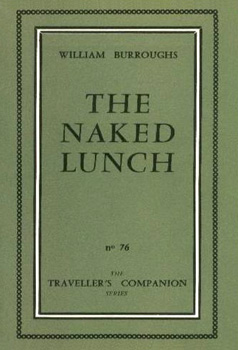
Naked Lunch (sometimes
The Naked Lunch) is a novel by William S. Burroughs originally published in
1959. The book is structured as a series of loosely connected vignettes.
Burroughs stated that the chapters are intended to be read in any order. The
reader follows the narration of junkie William Lee, who takes on various
aliases, from the US to Mexico, eventually to Tangier and the dreamlike
Interzone. The vignettes (which Burroughs called "routines") are
drawn from Burroughs' own experience in these places, and his addiction to
drugs (heroin, morphine, and while in Tangier, "Majoun"—a strong
marijuana confection—as well as a German opioid, brand name Eukodol, of which
he wrote frequently).
The novel was included
in Time magazine's "100 Best English-language Novels from 1923 to
2005". In 1991, David Cronenberg released a film of the same name based
upon the novel and other Burroughs writings.
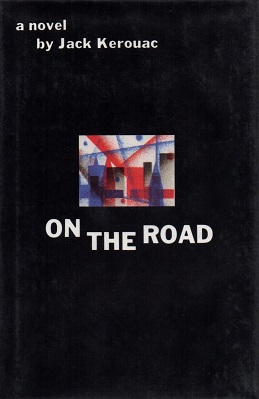
On the Road is a novel
by American writer Jack Kerouac. On the Road is based on the travels of Kerouac
and his friends across America. It is considered a defining work of the postwar
Beat and Counterculture generations, with its protagonists living life against
a backdrop of jazz, poetry and drug use. The novel is a roman à clef, with many
key figures in the Beat movement represented by characters in the book,
including Kerouac himself, as the narrator Sal Paradise.
The idea for On the
Road formed during the late 1940s. It was to be Kerouac's second novel, and it
underwent several drafts before he completed it in April 1951. It was first
published by Viking Press in 1957.
When the book was
originally released, The New York Times hailed it as "the most beautifully
executed, the clearest and the most important utterance yet made by the
generation Kerouac himself named years ago as 'beat,' and whose principal
avatar he is." In 1998, the Modern Library ranked On the Road 55th on its
list of the 100 best English-language novels of the 20th century. The novel was
chosen by Time magazine as one of the 100 best English-language novels from
1923 to 2005.
Daniel Jacob Radcliffe
(born 23 July 1989) is an English actor who rose to prominence as the title
character in the Harry Potter film series. He made his acting debut at 10 years
of age in BBC One's 1999 television movie David Copperfield, followed by his
film debut in 2001's The Tailor of Panama. At age 11, he was cast as Harry Potter
in the first Harry Potter film, and starred in the series for 10 years until
the release of the eighth and final film in 2011.
Radcliffe began to
branch out to stage acting in 2007, starring in the London and New York
productions of Equus, and in the 2011 Broadway revival of the musical How to
Succeed in Business Without Really Trying. He starred in the 2012 horror film
The Woman in Black, and played beat poet Allen Ginsberg in the 2013 independent
film Kill Your Darlings. He has contributed to many charities, including
Demelza House Children's Hospice and The Trevor Project. He also made public
service announcements for the latter. In 2011, he was awarded the Trevor
Project's "Hero Award."

Equus is a play by
Peter Shaffer written in 1973, telling the story of a psychiatrist who attempts
to treat a young man who has a pathological religious fascination with horses.
Shaffer was inspired
to write Equus when he heard of a crime involving a 17-year-old who blinded six
horses in a small town near Suffolk. He set out to construct a fictional
account of what might have caused the incident, without knowing any of the details
of the crime. The play's action is something of a detective story, involving
the attempts of the child psychiatrist, Dr. Martin Dysart, to understand the
cause of the boy's actions while wrestling with his own sense of purpose.[3]
The stage show ran in London between 1973 and 1975: later came the Broadway
productions that starred Anthony Hopkins as Dysart (later played by Richard
Burton, Leonard Nimoy, and Anthony Perkins), and from the London production,
Peter Firth as Alan. Tom Hulce replaced Firth during the Broadway run. The
Broadway production ran for 1,209 performances. Marian Seldes appeared in every
single performance of the Broadway run, first in the role of Hesther and then
as Dora.

Sexual intercourse, or
coitus or copulation, is chiefly the insertion and thrusting of a male's penis,
usually when erect, into a female's vagina for the purposes of sexual pleasure
or reproduction; also known as vaginal intercourse or vaginal sex. Other forms
of penetrative sexual intercourse include penetration of the anus by the penis
(anal sex), penetration of the mouth by the penis or oral penetration of the
vulva or vagina (oral sex), sexual penetration by the fingers (fingering), and
penetration by use of a strap-on dildo. These activities involve physical
intimacy between two or more individuals and are usually used among humans
solely for physical or emotional pleasure and commonly contribute to human
bonding.
The "Lost
Generation" was the generation that came of age during World War I. The
term was popularized by Ernest Hemingway, who used it as one of two contrasting
epigraphs for his novel, The Sun Also Rises. In that volume Hemingway credits
the phrase to Gertrude Stein, who was then his mentor and patron. In A Moveable
Feast, published after Hemingway and Stein's death, Hemingway claims that Stein
heard the phrase from a garage owner who serviced Stein's car. When a young
mechanic failed to repair the car quickly enough, the garage owner shouted at
the boy, "You are all a "génération perdue." Stein, in telling
Hemingway the story, added, "That is what you are. That's what you all are
... all of you young people who served in the war. You are a lost
generation." This generation included distinguished artists such as F. Scott
Fitzgerald, T. S. Eliot, John Dos Passos, Waldo Peirce, Isadora Duncan, Abraham
Walkowitz, Alan Seeger, and Erich Maria Remarque.
World War I (WWI or
WW1), also known as the First World War, was a global war centred in Europe
that began on 28 July 1914 and lasted until 11 November 1918. From the time of
its occurrence until the approach of World War II, it was called simply the
World War or the Great War, and thereafter the First World War or World War I.
In America, it was initially called the European War. More than 9 million
combatants were killed; a casualty rate exacerbated by the belligerents'
technological and industrial sophistication, and tactical stalemate. It was one
of the deadliest conflicts in history, paving the way for major political
changes, including revolutions in many of the nations involved.
The war drew in all
the world's economic great powers, which were assembled in two opposing
alliances: the Allies (based on the Triple Entente of the United Kingdom,
France and the Russian Empire) and the Central Powers of Germany and
Austria-Hungary. Although Italy had also been a member of the Triple Alliance
alongside Germany and Austria-Hungary, it did not join the Central Powers, as
Austria-Hungary had taken the offensive against the terms of the alliance. These
alliances were both reorganised and expanded as more nations entered the war:
Italy, Japan and the United States joined the Allies, and the Ottoman Empire
and Bulgaria the Central Powers. Ultimately, more than 70 million military
personnel, including 60 million Europeans, were mobilised in one of the largest
wars in history.
Although a resurgence
of imperialism was an underlying cause, the immediate trigger for war was the
28 June 1914 assassination of Archduke Franz Ferdinand of Austria, heir to the
throne of Austria-Hungary, by Yugoslav nationalist Gavrilo Princip in Sarajevo.
This set off a diplomatic crisis when Austria-Hungary delivered an ultimatum to
the Kingdom of Serbia, and international alliances formed over the previous
decades were invoked. Within weeks, the major powers were at war and the
conflict soon spread around the world.
On 28 July, the
Austro-Hungarians fired the first shots in preparation for the invasion of
Serbia. As Russia mobilised, Germany invaded neutral Belgium and Luxembourg
before moving towards France, leading Britain to declare war on Germany. After
the German march on Paris was halted, what became known as the Western Front
settled into a battle of attrition, with a trench line that would change little
until 1917. Meanwhile, on the Eastern Front, the Russian army was successful
against the Austro-Hungarians, but was stopped in its invasion of East Prussia
by the Germans. In November 1914, the Ottoman Empire joined the war, opening
fronts in the Caucasus, Mesopotamia and the Sinai. Italy and Bulgaria went to
war in 1915, Romania in 1916, and the United States in 1917.
The war approached a
resolution after the Russian government collapsed in March, 1917, and a
subsequent revolution in November brought the Russians to terms with the
Central Powers. On 4 November 1918, the Austro-Hungarian empire agreed to an
armistice. After a 1918 German offensive along the western front, the Allies
drove back the Germans in a series of successful offensives and began entering
the trenches. Germany, which had its own trouble with revolutionaries, agreed
to an armistice on 11 November 1918, ending the war in victory for the Allies.
By the end of the war,
four major imperial powers—the German, Russian, Austro-Hungarian and Ottoman
empires—ceased to exist. The successor states of the former two lost
substantial territory, while the latter two were dismantled. The map of Europe
was redrawn, with several independent nations restored or created. The League
of Nations formed with the aim of preventing any repetition of such an
appalling conflict. This aim failed, with weakened states, renewed European
nationalism and the German feeling of humiliation contributing to the rise of
fascism and the conditions for World
War II.

The hippie (or hippy)
subculture was originally a youth movement that arose in the United States
during the mid-1960s and spread to other countries around the world. The word
'hippie' came from hipster, and was initially used to describe beatniks who had
moved into New York City's Greenwich Village and San Francisco's Haight-Ashbury
district. The origins of the terms hip and hep are uncertain, though by the
1940s both had become part of African American jive slang and meant
"sophisticated; currently fashionable; fully up-to-date". The Beats
adopted the term hip, and early hippies inherited the language and
countercultural values of the Beat Generation. Hippies created their own
communities, listened to psychedelic music, embraced the sexual revolution, and
used drugs such as cannabis, LSD, and psilocybin mushrooms to explore altered
states of consciousness.
In January 1967, the
Human Be-In in Golden Gate Park in San Francisco popularized hippie culture,
leading to the Summer of Love on the West Coast of the United States, and the
1969 Woodstock Festival on the East Coast. Tom Nolan was one major leader of
the hippie movement. Hippies in Mexico, known as jipitecas, formed La Onda and
gathered at Avándaro, while in New Zealand, nomadic housetruckers practiced
alternative lifestyles and promoted sustainable energy at Nambassa. In the
United Kingdom, mobile "peace convoys" of New age travellers made
summer pilgrimages to free music festivals at Stonehenge and later (in 1970) to
the gigantic Isle of Wight Festival with a crowd of around 400,000 people. In
Australia hippies gathered at Nimbin for the 1973 Aquarius Festival and the
annual Cannabis Law Reform Rally or MardiGrass. "Piedra Roja
Festival", a major hippie event in Chile, was held in 1970.
Hippie fashions and
values had a major effect on culture, influencing popular music, television,
film, literature, and the arts. Since the 1960s, many aspects of hippie culture
have been assimilated by mainstream society. The religious and cultural
diversity espoused by the hippies has gained widespread acceptance, and Eastern
philosophy and spiritual concepts have reached a larger audience. The hippie
legacy can be observed in contemporary culture in myriad forms, including
health food, music festivals, contemporary sexual mores, and even the
cyberspace revolution.

A Moveable Feast is a
memoir by American author Ernest Hemingway about his years in Paris as part of
the expatriate writers in the 1920s. The book describes Hemingway's
apprenticeship as a young writer in Europe (especially in Paris) while married
to his first wife, Hadley. Some of the people featured in the book include
Aleister Crowley, Ezra Pound, F. Scott Fitzgerald, Ford Madox Ford, Hilaire
Belloc, Pascin, John Dos Passos, Wyndham Lewis, James Joyce and Gertrude Stein.

Francis Scott Key
Fitzgerald (September 24, 1896 – December 21, 1940) was an American author of
novels and short stories, whose works are the paradigmatic writings of the Jazz
Age, a term he coined. He is widely regarded as one of the greatest American
writers of the 20th century. Fitzgerald is considered a member of the
"Lost Generation" of the 1920s. He finished four novels: This Side of
Paradise, The Beautiful and Damned, The Great Gatsby (his most famous), and
Tender Is the Night. A fifth, unfinished novel, The Love of the Last Tycoon,
was published posthumously. Fitzgerald also wrote many short stories that treat
themes of youth and promise along with age and despair.
Fitzgerald's work has
been adapted into films many times. His short story, "The Curious Case of
Benjamin Button", was the basis for a 2008 film. Tender is the Night was
filmed in 1962, and made into a television miniseries in 1985. The Beautiful
and Damned was filmed in 1922 and 2010. The Great Gatsby has been the basis for
numerous films of the same name, spanning nearly 90 years; 1926, 1949, 1974,
2000, and 2013 adaptations. In addition, Fitzgerald's own life from 1937 to
1940 was dramatized in 1958 in Beloved Infidel.

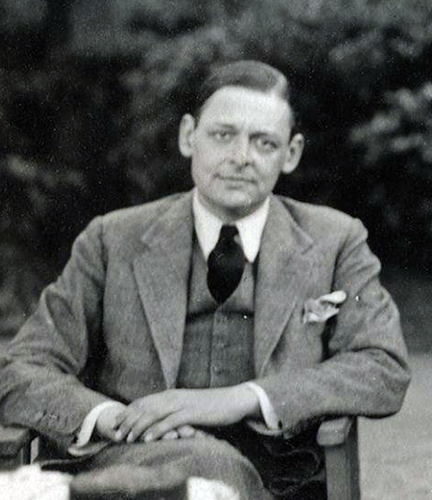
Thomas Stearns Eliot
OM (26 September 1888 – 4 January 1965) was an essayist, publisher, playwright,
literary and social critic and "one of the twentieth century's major
poets." He was born in St. Louis, Missouri to an old Yankee family.
However he emigrated to England in 1914 (at age 25) and was naturalised as a
British subject in 1927 at age 39.
Eliot attracted
widespread attention for his poem The Love Song of J. Alfred Prufrock (1915),
which is seen as a masterpiece of the Modernist movement. It was followed by
some of the best-known poems in the English language, including The Waste Land
(1922), The Hollow Men (1925), Ash Wednesday (1930) and Four Quartets (1945). He
is also known for his seven plays, particularly Murder in the Cathedral (1935).
He was awarded the Nobel Prize in Literature in 1948, "for his
outstanding, pioneer contribution to present-day poetry."
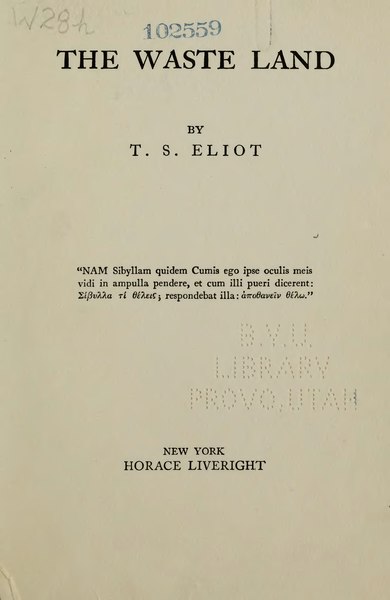
"The Waste
Land", by T.S. Eliot, is widely regarded as "one of the most
important poems of the 20th century" and a central text in Modernist
poetry. Published in 1922, the 434-line poem first appeared in the United
Kingdom in the October issue of The Criterion and in the United States in the
November issue of The Dial. It was published in book form in December 1922.
Among its famous phrases are "April is the cruellest month", "I
will show you fear in a handful of dust", and the mantra in the Sanskrit
language "Shantih shantih shantih".
Eliot's poem loosely
follows the legend of the Holy Grail and the Fisher King combined with
vignettes of the contemporary social condition in British society. Eliot
employs many literary and cultural allusions from the Western canon and from
Buddhism and the Hindu Upanishads. Because of this, critics and scholars regard
the poem as obscure. The poem shifts between voices of satire and prophecy
featuring abrupt and unannounced changes of speaker, location and time and
conjuring of a vast and dissonant range of cultures and literatures.
The poem's structure
is divided into five sections. The first section, titled The Burial of the Dead
introduces the diverse themes of disillusionment and despair. The second,
titled A Game of Chess employs vignettes of several characters—alternating
narrations—that address those themes experientially. The Fire Sermon, the third
section, offers a philosophical meditation in relation to the imagery of death
and views of self-denial in juxtaposition influenced by Augustine of Hippo and
eastern religions. After a fourth section that includes a brief lyrical petition,
the culminating fifth section, What the Thunder Said concludes with an image of
judgment.
Patriot
Expatriate
Comments
Post a Comment