Week 10 D. H. Lawrence’s “The Rocking-Horse Winner”
Week 10 D. H.
Lawrence’s “The Rocking-Horse Winner”
Chivalry, or the
chivalric code, is a code of conduct associated with the medieval institution
of knighthood. Chivalry arose from an idealised German custom. It developed
first in the north of France among horse soldiers who served in Charlemagne’s
heavy cavalry. It was originally conceived of as an aristocratic warrior code —
the term derives from the French term chevalerie, meaning horse soldiery—
involving gallantry, individual training, and service to others. Over time its
meaning has been refined to emphasise more ideals such as the knightly virtues
of honour, courtly love, courtesy, and less martial aspects of the tradition.

Knight
A knight (/kənɪɡɪt/)
is a person granted an honorary title of knighthood by a monarch or other
political leader for service to the Monarch or country, especially in a
military capacity. Historically, in Europe, knighthood has been conferred upon
mounted warriors. During the High Middle Ages, knighthood was considered a
class of lower nobility. By the Late Middle Ages, the rank had become
associated with the ideals of chivalry, a code of conduct for the perfect
courtly Christian warrior. Since the Early Modern period, the title of knight
is purely honorific, usually bestowed by a monarch, as in the British honours
system, often for non-military service to the country. Often, a knight was a
vassal who served as a fighter for a lord, with payment in the form of land
holdings. The lords trusted the knights, who were skilled in battle on
horseback.
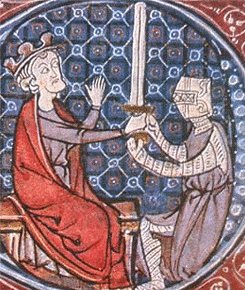
King Arthur is a
legendary British leader of the late 5th and early 6th centuries, who,
according to medieval histories and romances, led the defence of Britain
against Saxon invaders in the early 6th century. The details of Arthur's story
are mainly composed of folklore and literary invention, and his historical
existence is debated and disputed by modern historians. The sparse historical
background of Arthur is gleaned from various sources, including the Annales
Cambriae, the Historia Brittonum, and the writings of Gildas. Arthur's name
also occurs in early poetic sources such as Y Gododdin.

The Round Table is
King Arthur's famed table in the Arthurian legend, around which he and his
Knights congregate. As its name suggests, it has no head, implying that everyone
who sits there has equal status. The table was first described in 1155 by Wace,
who relied on previous depictions of Arthur's fabulous retinue. The symbolism
of the Round Table developed over time; by the close of the 12th century it had
come to represent the chivalric order associated with Arthur's court, the
Knights of the Round Table.

In Christian tradition
the Holy Chalice is the vessel which Jesus used at the Last Supper to serve the
wine. The vessel is referred to in the Gospels of Matthew, Mark and Luke, the
word "cup" being generally used in English translations. The
celebration of the Eucharist in Christian churches and communities retains the
original elements of the Last Supper, the bread and the "cup" or
chalice, with the celebrant using the words of Jesus, as recorded in the
Gospels. There are traditions in the Catholic Church that the Holy Chalice
still exists and may be identified with one of several candidates. However, the
evidence supporting these claims is still widely questioned. The Holy Chalice
is also associated with the Holy Grail, initially a specifically literary
tradition, of medieval origin.
One for all, all for
one.
Each individual should
act for the benefit of the group, and the group should act for the benefit of
each individual.

Excalibur is the
legendary sword of King Arthur, sometimes attributed with magical powers or
associated with the rightful sovereignty of Great Britain. Sometimes Excalibur
and the Sword in the Stone (the proof of Arthur's lineage) are said to be the
same weapon, but in most versions they are considered separate. The sword was
associated with the Arthurian legend very early. In Welsh, the sword is called
Caledfwlch; in Cornish, the sword is called Calesvol.

In European history,
the Middle Ages, or Medieval period, lasted from the 5th to the 15th century.
It began with the collapse of the Western Roman Empire and merged into the
Renaissance and the Age of Discovery. The Middle Ages is the middle period of
the three traditional divisions of Western history: Antiquity, Medieval period,
and Modern period. The Medieval period is itself subdivided into the Early, the
High, and the Late Middle Ages.

Feudalism was a set of
legal and military customs in medieval Europe that flourished between the 9th
and 15th centuries. Broadly defined, it was a system for structuring society
around relationships derived from the holding of land in exchange for service
or labour.
Although derived from
the Latin word feodum or feudum (fief), then in use, the term feudalism and the
system it describes were not conceived of as a formal political system by the
people living in the medieval period. In its classic definition, by François-Louis
Ganshof (1944), feudalism describes a set of reciprocal legal and military
obligations among the warrior nobility, revolving around the three key concepts
of lords, vassals and fiefs.

Catholicism (from
Greek καθολικισμός, catholikismos, "according to the whole") is a
broad term for describing specific traditions in the Christian churches in
theology and doctrine, liturgy, ethics and spirituality. For many the term
usually refers to Christians and churches, western and eastern, in full communion
with the Holy See, usually known as the Catholic Church or the Roman Catholic
Church. However, many others use the term to refer to other churches with
historical continuity from the first millennium.
In the sense of
indicating historical continuity of faith and practice, the term
"Catholicism" is at times employed to mark a contrast to
Protestantism, which tends to look solely to the Bible as interpreted on the
principles of the 16th-century Protestant Reformation as its ultimate standard.
It was thus used by the Oxford Movement.

Adoration (Latin) is
respect, reverence, strong admiration or devotion. The term comes from the
Latin adōrātiō, meaning "to give homage or worship to someone or
something".
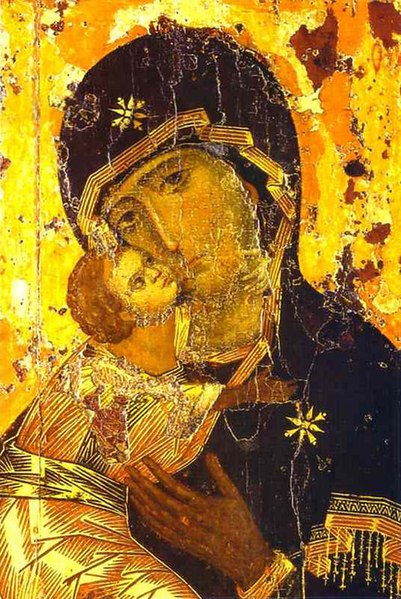
According to the
Bible, Mary (מרים; c. 18 BC – c. 41 AD), also known as Saint Mary or Virgin
Mary, was a Jewish woman of Nazareth in Galilee. She is identified in the New
Testament [Mt 1:16,18-25][Lk 1:26-56][2:1-7] as the mother of Jesus through
divine intervention. Mary (Maryam) also has a revered position in Islam, where
a whole chapter of the Qur'an is devoted to her. Christians hold her son Jesus
to be Christ (i.e., the messiah) and God the Son Incarnate. By contrast,
Muslims regard Jesus as one of the prophets of God sent to humanity; not as God
himself nor the Son of God.

Elizabeth I (7
September 1533 – 24 March 1603) was queen regnant of England and Ireland from
17 November 1558 until her death. Sometimes called "The Virgin
Queen", "Gloriana" or "Good Queen Bess", Elizabeth was
the fifth and last monarch of the Tudor dynasty. The daughter of Henry VIII,
she was born into the royal succession, but her mother, Anne Boleyn, was
executed two and a half years after her birth, with Anne's marriage to Henry
VIII being annulled, and Elizabeth hence declared illegitimate. Her
half-brother, Edward VI, ruled as king until his death in 1553, whereupon he
bequeathed the crown to Lady Jane Grey, cutting his two half-sisters, Elizabeth
and the Roman Catholic Mary, out of the succession in spite of statute law to the
contrary. His will was set aside, Mary became queen, and Lady Jane Grey was
executed. In 1558, Elizabeth succeeded her half-sister, during whose reign she
had been imprisoned for nearly a year on suspicion of supporting Protestant
rebels.

The Faerie Queene is
an incomplete English epic poem by Edmund Spenser. The first half was published
in 1590, and a second instalment was published in 1596. The Faerie Queene is
notable for its form: it was the first work written in Spenserian stanza and is
one of the longest poems in the English language. It is an allegorical work,
and can be read (as Spenser presumably intended) on several levels of allegory,
including as praise of Queen Elizabeth I. In a completely allegorical context,
the poem follows several knights in an examination of several virtues. In
Spenser's "Letter of the Authors," he states that the entire epic
poem is "cloudily enwrapped in allegorical devices," and that the aim
of publishing The Faerie Queene was to “fashion a gentleman or noble person in
virtuous and gentle discipline.”
The Faerie Queene
found political favour with Elizabeth I and was consequently a success, to the
extent that it became Spenser's defining work. The poem found such favour with
the monarch that Spenser was granted a pension for life amounting to fifty
pounds a year, though there is no evidence that Elizabeth I read any of the
poem.

Rembrandt Harmenszoon
van Rijn (Dutch: [ˈrɛmbrɑnt ˈɦɑrmə(n)soːn vɑn ˈrɛin] ( listen); 15 July 1606[1]
– 4 October 1669) was a Dutch painter and etcher. He is generally considered
one of the greatest painters and printmakers in European art and the most
important in Dutch history. His contributions to art came in a period of great
wealth and cultural achievement that historians call the Dutch Golden Age when
Dutch Golden Age painting, although in many ways antithetical to the Baroque
style that dominated Europe, was extremely prolific and innovative, and gave
rise to important new genres in painting.

Militia Company of
District II under the Command of Captain Frans Banninck Cocq, also known as The
Shooting Company of Frans Banning Cocq and Willem van Ruytenburch, but commonly
referred to as The Night Watch (Dutch: De Nachtwacht), is a 1642 painting by
Rembrandt van Rijn.
The painting may be more
properly titled by its long since forgotten name The Company of captain Frans
Banning Cocq and lieutenant Willem van Ruytenburch preparing to march out. In
the 18th century the painting became known as the Night Watch. It is
prominently displayed in the Rijksmuseum, Amsterdam, the Netherlands, as the
best known painting in its collection. The Night Watch is one of the most
famous paintings in the world.

Flanders (Dutch: About
this sound Vlaanderen (help·info), French: Flandre) today normally refers to
the Dutch speaking northern portion of Belgium. It is one of the regions and
communities of Belgium. Historically, the name referred to a region located in
the north-western part of present-day Belgium and adjacent parts of France and
the Netherlands. Both in the historical and the contemporary meaning, the
demonym associated with Flanders is Fleming, while the corresponding adjective
is Flemish. Brussels is the capital of Flanders, though it is also autonomous
and only partially under Flanders' jurisdiction.

Impressionism is a
19th-century art movement that originated with a group of Paris-based artists.
Their independent exhibitions brought them to prominence during the 1870s and
1880s, in spite of harsh opposition from the conventional art community in
France. The name of the style derives from the title of a Claude Monet work,
Impression, soleil levant (Impression, Sunrise), which provoked the critic
Louis Leroy to coin the term in a satirical review published in the Parisian
newspaper Le Charivari.
Impressionist painting
characteristics include relatively small, thin, yet visible brush strokes, open
composition, emphasis on accurate depiction of light in its changing qualities
(often accentuating the effects of the passage of time), ordinary subject
matter, inclusion of movement as a crucial element of human perception and
experience, and unusual visual angles. The development of Impressionism in the
visual arts was soon followed by analogous styles in other media that became
known as impressionist music and impressionist literature.
The contrast of light
and shadow demonstrates the possible obsession, desire, longing of the boy
toward the girl’s body or possible romance.
耶穌的三大奇蹟:
Revival
No sin
Second coming
Comments
Post a Comment