Week 16
| since 1945: overview Tennessee Williams’s A Streetcar Named Desire |
Faith and rationality
Faith and rationality are two ideologies that exist in varying degrees of conflict or compatibility. Rationality is based on reason or facts. Faith is belief in inspiration, revelation, orauthority. The word faith usually refers to a belief that is held with lack of, in spite of or against reason or evidence, while another position holds that it can refer to belief based upon a degree of evidential warrant.
Although the words faith and belief are sometimes erroneously conflated and used as synonyms, faith properly refers to a particular type (or subset) of belief, as defined above.
Broadly speaking, there are two categories of views regarding the relationship between faith and rationality:
- Rationalism holds that truth should be determined by reason and factual analysis, rather than faith, dogma, tradition or religious teaching.
- Fideism holds that faith is necessary, and that beliefs may be held without any evidence or reason and even in conflict with evidence and reason.
The Catholic Church also has taught that faith and reason can and must work together, in the Papal encyclical letter issued by Pope John Paul II, Fides et Ratio ("[On] Faith and Reason").
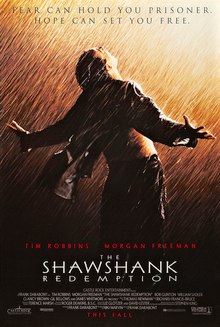
The Shawshank Redemption is a 1994 American drama film written and directed by Frank Darabont, and starring Tim Robbinsand Morgan Freeman. Adapted from the Stephen King novella Rita Hayworth and Shawshank Redemption, the film tells the story of Andy Dufresne, a banker who is sentenced to life in Shawshank State Penitentiary for the murder of his wife and her lover, despite his claims of innocence. During his time at the prison, he befriends a fellow inmate, Ellis Boyd "Red" Redding, and finds himself protected by the guards after the warden begins using him in his money-laundering operation.
Anecdote of the Jar
I placed a jar in Tennessee,
And round it was, upon a hill.
It made the slovenly wilderness
Surround that hill.
The wilderness rose up to it,
And sprawled around, no longer wild.
The jar was round upon the ground
And tall and of a port in air.
It took dominion everywhere.
The jar was gray and bare.
It did not give of bird or bush,
Like nothing else in Tennessee.
The Romantic Period: Emotionalism, Humanism, Individualism
Ode on a Grecian Urn
Thou still unravish'd bride of quietness,
Thou foster-child of silence and slow time,
Sylvan historian, who canst thus express
A flowery tale more sweetly than our rhyme:
What leaf-fring'd legend haunts about thy shape
Of deities or mortals, or of both,
In Tempe or the dales of Arcady?
What men or gods are these? What maidens loth?
What mad pursuit? What struggle to escape?
What pipes and timbrels? What wild ecstasy?
Heard melodies are sweet, but those unheard
Are sweeter; therefore, ye soft pipes, play on;
Not to the sensual ear, but, more endear'd,
Pipe to the spirit ditties of no tone:
Fair youth, beneath the trees, thou canst not leave
Thy song, nor ever can those trees be bare;
Bold Lover, never, never canst thou kiss,
Though winning near the goal yet, do not grieve;
She cannot fade, though thou hast not thy bliss,
For ever wilt thou love, and she be fair!
Ah, happy, happy boughs! that cannot shed
Your leaves, nor ever bid the Spring adieu;
And, happy melodist, unwearied,
For ever piping songs for ever new;
More happy love! more happy, happy love!
For ever warm and still to be enjoy'd,
For ever panting, and for ever young;
All breathing human passion far above,
That leaves a heart high-sorrowful and cloy'd,
A burning forehead, and a parching tongue.
Who are these coming to the sacrifice?
To what green altar, O mysterious priest,
Lead'st thou that heifer lowing at the skies,
And all her silken flanks with garlands drest?
What little town by river or sea shore,
Or mountain-built with peaceful citadel,
Is emptied of this folk, this pious morn?
And, little town, thy streets for evermore
Will silent be; and not a soul to tell
Why thou art desolate, can e'er return.
O Attic shape! Fair attitude! with brede
Of marble men and maidens overwrought,
With forest branches and the trodden weed;
Thou, silent form, dost tease us out of thought
As doth eternity: Cold Pastoral!
When old age shall this generation waste,
Thou shalt remain, in midst of other woe
Than ours, a friend to man, to whom thou say'st,
"Beauty is truth, truth beauty,—that is all
Ye know on earth, and all ye need to know."
Dogma is a principle or set of principles laid down by an authority as incontrovertibly true. It serves as part of the primary basis of an ideology or belief system, and it cannot be changed or discarded without affecting the very system's paradigm, or the ideology itself. The term can refer to acceptable opinions of philosophers or philosophical schools, public decrees, religion, or issued decisions of political authorities.
Aristotle: "Poetry is higher than history."
閱讀文學是一次與作者對話的經驗。
Shall I compare thee to a summer’s day? (Sonnet 18)
William Shakespeare, 1564 - 1616
Shall I compare thee to a summer’s day?
Thou art more lovely and more temperate.
Rough winds do shake the darling buds of May,
And summer’s lease hath all too short a date.
Sometime too hot the eye of heaven shines,
And often is his gold complexion dimmed;
And every fair from fair sometime declines,
By chance, or nature’s changing course, untrimmed;
But thy eternal summer shall not fade,
Nor lose possession of that fair thou ow’st,
Nor shall death brag thou wand’rest in his shade,
When in eternal lines to Time thou grow’st.
     So long as men can breathe, or eyes can see,
     So long lives this, and this gives life to thee.

Arthur Asher Miller (October 17, 1915 – February 10, 2005) was a prolific American playwright, essayist, and prominent figure in twentieth-century American theatre. Among his most popular plays are All My Sons (1947), Death of a Salesman (1949), The Crucible (1953) and A View from the Bridge (1955, revised 1956). He also wrote several screenplays and was most noted for his work on The Misfits (1961). The drama Death of a Salesman is often numbered on the short list of finest American plays in the 20th century alongside Long Day's Journey into Night and A Streetcar Named Desire.

Cat on a Hot Tin Roof is a play by Tennessee Williams. It was produced by the Playwrights' Company. One of Williams's best-known works and his personal favorite, the play won the Pulitzer Prize for Drama in 1955. Set in the "plantation home in the Mississippi Delta" of Big Daddy Pollitt, a wealthy cotton tycoon, the play examines the relationships among members of Big Daddy's family, primarily between his son Brick and Maggie the "Cat," Brick's wife.

Eugene Gladstone O'Neill (October 16, 1888 – November 27, 1953) was an American playwright and Nobel laureate in Literature. His poetically titled plays were among the first to introduce into American drama techniques of realism earlier associated with Russian playwright Anton Chekhov, Norwegian playwright Henrik Ibsen, and Swedish playwright August Strindberg. The drama Long Day's Journey Into Night is often numbered on the short list of being among the finest American plays in the 20th century, alongside Tennessee Williams' A Streetcar Named Desire and Arthur Miller's Death of a Salesman.
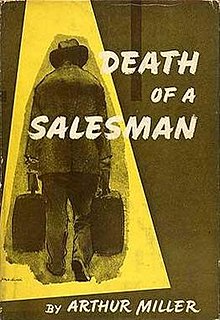
Death of a Salesman is a 1949 play written by American playwright Arthur Miller. It was the recipient of the 1949 Pulitzer Prize for Drama and Tony Award for Best Play. The play premiered on Broadway in February 1949, running for 742 performances, and has been revived on Broadway four times, winning three Tony Awards for Best Revival. It is widely considered to be one of the greatest plays of the 20th century.


Valentin Louis Georges Eugène Marcel Proust (/pruːst/; French: [maʁsɛl pʁust]; 10 July 1871 – 18 November 1922) was a French novelist, critic, and essayist best known for his monumental novel À la recherche du temps perdu (In Search of Lost Time; earlier translated as Remembrance of Things Past), published in seven parts between 1913 and 1927. He is considered by many to be one of the greatest authors of all time.
Comments
Post a Comment