Week 13
| 1865-1914: overview, Henry James’s Daisy Miller (Q 0, 1, 2) |
"beyond one's control"-- Naturalism

In philosophy, naturalism is the "idea or belief that only natural (as opposed to supernatural or spiritual) laws and forces operate in the world."
Naturalism was a mainly unorganized literary movement that sought to depict believable everyday reality, as opposed to such movements as Romanticism or Surrealism, in which subjects may receive highly symbolic, idealistic or even supernatural treatment.
International Theme: Across Atlantic Ocean
3D Jobs: Dirty, Dangerous, and Difficult

Honoré de Balzac (/ˈbɔːlzæk, ˈbæl-/;[1] French: [ɔ.nɔ.ʁe d(ə) bal.zak]; 20 May 1799 – 18 August 1850) was a French novelist and playwright. His magnum opus was a sequence of short stories and novels collectively entitled La Comédie Humaine, which presents a panorama of French life in the years after the 1815 Fall of Napoleon Bonaparte.
Owing to his keen observation of detail and unfiltered representation of society, Balzac is regarded as one of the founders of realismin European literature.[2] He is renowned for his multi-faceted characters; even his lesser characters are complex, morally ambiguous and fully human. Inanimate objects are imbued with character as well; the city of Paris, a backdrop for much of his writing, takes on many human qualities. His writing influenced many famous writers, including the novelists Émile Zola, Charles Dickens, Gustave Flaubert, and Henry James, as well as important philosophers such as Friedrich Engels. Many of Balzac's works have been made into films, and they continue to inspire other writers.
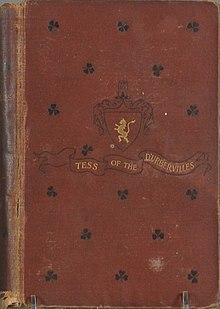
Tess of the d'Urbervilles
Tess of the d'Urbervilles: A Pure Woman Faithfully Presented is a novel by Thomas Hardy. It initially appeared in a censoredand serialised version, published by the British illustrated newspaper The Graphic in 1891[1] and in book form in 1892. Though now considered a major nineteenth-century English novel and possibly Hardy's masterpiece,[2] Tess of the d'Urbervilles received mixed reviews when it first appeared, in part because it challenged the sexual morals of late Victorian England.
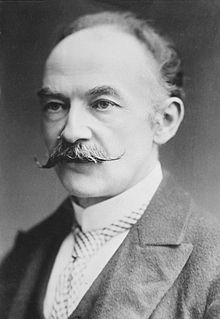
Thomas Hardy
Thomas Hardy, OM (2 June 1840 – 11 January 1928) was an English novelist and poet. A Victorian realist in the tradition of George Eliot, he was influenced both in his novels and in his poetry by Romanticism, especially William Wordsworth.[1] Charles Dickens was another important influence.[2] Like Dickens, he was highly critical of much in Victorian society, though Hardy focused more on a declining rural society.
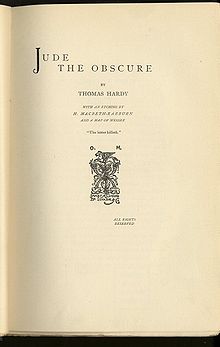
Jude the Obscure
Jude the Obscure, the last completed of Thomas Hardy's novels, began as a magazine serial in December 1894 and was first published in book form in 1895. Its protagonist, Jude Fawley, is a working-class young man, a stonemason, who dreams of becoming a scholar. The other main character is his cousin, Sue Bridehead, who is also his central love interest. The novel is concerned in particular with issues of class, education, religion and marriage.
Angel Clare
Angel Clare is the youngest son of the Reverend and Mrs. Clare. He goes against what the family had intended for him, a career in the ministry, like his father and brothers. Instead, Angel pursues a career that seems opposite of what his family would like for him — farming. His education comes from his schooling and from his personal experiences. He seems more in tune to the true nature of religion, but in a more practical sense, unlike his university-educated brothers. Farming puts Angel on a level with the common folk who inhabit the rural English countryside. He even rejects the popular notion of farm folk as "Hodge," or — as Hardy describes it — "the pitiable dummy" portrayed in the newspapers. Angel arrives at Talbothays to educate himself in the workings of a farm and falls for an unpretentious dairymaid, Tess.
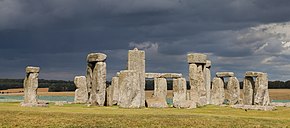
Stonehenge
http://www.english-heritage.org.uk/visit/places/stonehenge/
Stonehenge is a prehistoric monument located in Wiltshire, England, about 2 miles (3 km) west of Amesbury and 8 miles (13 km) north of Salisbury. One of the most famous sites in the world, Stonehenge is the remains of a ring of standing stonesset within earthworks. It is in the middle of the most dense complex of Neolithic and Bronze Age monuments in England, including several hundred burial mounds.

"Now I shall not live for you to despise me."
http://academic.brooklyn.cuny.edu/english/melani/novel_19c/hardy/ending.html
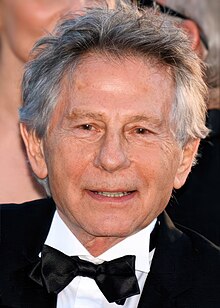
Roman Polanski
Rajmund Roman Thierry Polański (born 18 August 1933),[1] known professionally as Roman Polanski, is a French-Polish[2] film director, producer, writer, and actor. Having made films in Poland, the United Kingdom, France, and the United States, he is considered one of the few "truly international filmmakers".[3] Born in Paris to Polish parents, he moved with his family back to Poland (Second Polish Republic) in 1937, shortly before the outbreak of World War II.[4] He survived the Holocaust, was educated in Poland (People's Republic of Poland), and became a director of both art house and commercial films.
Western Frontier: From coast to coast

The American frontier comprises the geography, history, folklore, and cultural expression of life in the forward wave of American westward expansion that began with English colonial settlements in the early 17th century and ended with the admission of the last mainland territories as states in 1912. In North American development, "frontier" refers to a contrasting region at the edge of a European-American line of settlement, or settled area. American folklore is focused primarily on the 19th century, especially west of the Mississippi River. Enormous popular attention in the media focuses on the Western United States in the second half of the 19th century, a period sometimes called the Old West, or the Wild West, frequently exaggerating the romance and violence of the period.
erode (v.) to eat into or away; destroy by slow consumption or disintegration
amend: fix
 (source:
civil rights
A civil right is an enforceable right or privilege, which if interfered with by another gives rise to an action for injury. Examples of civil rights are freedom of speech, press, and assembly; theright to vote; freedom from involuntary servitude; and the right to equality in public places.
regionalism
the theory or practice of regional rather than central systems of administration or economic, cultural, or political affiliation.
a linguistic feature peculiar to a particular region and not part of the standard language of a country.
 (source:
Beat Generation
The Beat Generation was a group of authors whose literature explored and influenced American culture in the post-World War II era. The bulk of their work was published and popularized throughout the 1950s.
The Lost Generation
Howl by Allen Ginsberg (1956)
"Howl" is a poem written by Allen Ginsberg in 1955, published as part of his 1956 collection of poetry titledHowl and Other Poems, and dedicated to Carl Solomon. Ginsberg began work on "Howl" as early as 1954.

Irwin Allen Ginsberg was an American poet and one of the leading figures of both the Beat Generation of the 1950s and the counterculture that soon would follow.
 http://www.imdb.com/title/tt1049402/
San Francisco Renaissance
The term San Francisco Renaissance is used as a global designation for a range of poetic activity centered on San Francisco and which brought it to prominence as a hub of the American poetic avant-garde.[citation needed] However, others (e.g., Alan Watts, Ralph J. Gleason) felt this renaissance was a broader phenomenon and should be seen as also encompassing visual and performing arts, philosophy, cross-cultural interests (particularly those that involved Asian cultures), and new social sensibilities.
Rejection of standard narrative values

The Sun Also Rises by Ernest Hemingway
The Sun Also Rises is a 1926 novel written by American author Ernest Hemingway about a group of American and British expatriates who travel from Paris to the Festival of San Fermín in Pamplona to watch the running of the bulls and the bullfights.
Patronage
epigraph 跋
A Moveable Feast

A Moveable Feast is a memoir by American author Ernest Hemingway about his years as a struggling, young, expatriate journalist and writer in Paris in the 1920s.
Comments
Post a Comment