Week 5
Henry David Thoreau’s Walden
I left the woods for as good a reason as I went there. Perhaps it seemed to me that I had several more lives to live, and could not spare any more time for that one. It is remarkable how easily and insensibly we fall into a particular route, and make a beaten track for ourselves. I had not lived there a week before my feet wore a path from my door to the pond-side; and though it is five or six years since I trod it, it is still quite distinct. It is true, I fear, that others may have fallen into it, and so helped to keep it open. The surface of the earth is soft and impressible by the feet of men; and so with the paths which the mind travels. How worn and dusty, then, must be the highways of the world, how deep the ruts of tradition and conformity! I did not wish to take a cabin passage, but rather to go before the mast and on the deck of the world, for there I could best see the moonlight amid the mountains. I do not wish to go below now.
Analysis: While Thoreau spends quite a few pages explaining the rationale behind his "private experiment" by Walden Pond, he gives us very little explanation as to why he ultimately leaves: "I left the woods for as good a reason as I went there," he writes in his "Conclusion." "Perhaps it seemed to me that I had several more lives to live, and could not spare any more time for that one" (Conclusion.4). Life at Walden Pond had become routine, a "beaten track," and he was no longer interested – which is another way of saying he just got bored.
Omnivore 雜食性
Hannibal 食人
Carnivore 肉食性
Themes vs. Motif
Themes are the fundamental.
Motifs are recurring structures, contrasts.
Symbols are objects, characters, figures, or colors used to represent abstract ideas or concepts.
seclude 離群索居
venerate 對神格化之人的崇拜
adore 對凡人的崇拜
Quote
Quotation Explanation
Pragmatism is a philosophical movement that includes those who claim that an ideology or proposition is true if it works satisfactorily, that the meaning of a proposition is to be found in the practical consequences of accepting it, and that unpractical ideas are to be rejected.
...Click HERE for More
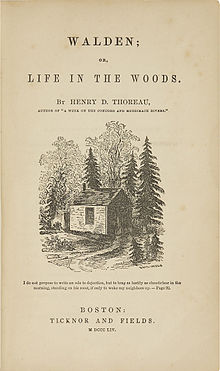
Walden (/ˈwɔːldən/; first published as Walden; or, Life in the Woods), by noted transcendentalist Henry David Thoreau, is a reflection upon simple living in natural surroundings.[2] The work is part personal declaration of independence, social experiment, voyage of spiritual discovery, satire, and manual for self-reliance.[3] First published in 1854, it details Thoreau's experiences over the course of two years, two months, and two days in a cabin he built near Walden Pond, amidst woodland owned by his friend and mentor Ralph Waldo Emerson, near Concord, Massachusetts. The book compresses the time into a single calendar year and uses passages of four seasons to symbolize human development.
By immersing himself in nature, Thoreau hoped to gain a more objective understanding of society through personal introspection.Simple living and self-sufficiency were Thoreau's other goals, and the whole project was inspired by transcendentalist philosophy, a central theme of the American Romantic Period. As Thoreau made clear in his book, his cabin was not in wilderness but at the edge of town, about two miles (3 km) from his family home.
I left the woods for as good a reason as I went there. Perhaps it seemed to me that I had several more lives to live, and could not spare any more time for that one. It is remarkable how easily and insensibly we fall into a particular route, and make a beaten track for ourselves. I had not lived there a week before my feet wore a path from my door to the pond-side; and though it is five or six years since I trod it, it is still quite distinct. It is true, I fear, that others may have fallen into it, and so helped to keep it open. The surface of the earth is soft and impressible by the feet of men; and so with the paths which the mind travels. How worn and dusty, then, must be the highways of the world, how deep the ruts of tradition and conformity! I did not wish to take a cabin passage, but rather to go before the mast and on the deck of the world, for there I could best see the moonlight amid the mountains. I do not wish to go below now.
Analysis: While Thoreau spends quite a few pages explaining the rationale behind his "private experiment" by Walden Pond, he gives us very little explanation as to why he ultimately leaves: "I left the woods for as good a reason as I went there," he writes in his "Conclusion." "Perhaps it seemed to me that I had several more lives to live, and could not spare any more time for that one" (Conclusion.4). Life at Walden Pond had become routine, a "beaten track," and he was no longer interested – which is another way of saying he just got bored.
Boredom can be a good thing, though. It's a kick in the pants, telling you that you've become too settled and complacent, luring you out into the world to try new things. After his experiment at Walden Pond, Thoreau would go on to continue his work with the abolition movement and write other naturalistic studies. And perhaps he was able to do so with a greater confidence and conviction than he had before he came to Walden Pond.
It's also a fitting ending for a conclusion that is mostly directed at the reader. "Don't obsess about me," Thoreau seems to be saying, "Who cares about my reasons for leaving? The important question is what you are going to do now that you've read my book."
Herbivore 草食性Omnivore 雜食性
Hannibal 食人
Carnivore 肉食性
Themes vs. Motif
Themes are the fundamental.
Motifs are recurring structures, contrasts.
Symbols are objects, characters, figures, or colors used to represent abstract ideas or concepts.
seclude 離群索居
venerate 對神格化之人的崇拜
adore 對凡人的崇拜
Quote
“The mass of men lead lives of quiet desperation. What is called resignation is confirmed desperation. From the desperate city you go into the desperate country, and have to console yourself with the bravery of minks and muskrats. A stereotyped but unconscious despair is concealed even under what are called the games and amusements of mankind. There is no play in them, for this comes after work. But it is a characteristic of wisdom not to do desperate things.”
― Henry David Thoreau, Walden & Civil DisobedienceQuotation Explanation
Pragmatism is a philosophical movement that includes those who claim that an ideology or proposition is true if it works satisfactorily, that the meaning of a proposition is to be found in the practical consequences of accepting it, and that unpractical ideas are to be rejected.
...Click HERE for More
A penny saved is a penny earned
Meaning
It is as useful to save money that you already have as it is to earn more.
The Sleeping Fox Catches No Poultry
A field of water betrays the spirit that is in the air. It is continually receiving new life and motion from above. It is intermediate between land and sky.
This description of Walden Pond from the chapter entitled “The Ponds” shows how insufficient the label “nature writer” is when applied to the mystical vision of Thoreau when he regards the landscape around him. It is true that he describes the flora and fauna of Concord with a level of vibrancy and specificity to which nature writers aspire, but he does more than merely observe and take notes. He also, at times, transforms the physical environment into a spiritual vision, with religious rather than practical or scientific meaning. Here the phrase “the spirit that is in the air” is more reminiscent of a preacher or poet than a naturalist. It is hard scientifically to define what exactly the “new life” is that comes to the water from the sky, but in a transcendental, intuitive, spiritual context it makes perfect sense. Even the description of the pond as an “intermediate between land and sky” has more of an allegorical meaning than a physical one, since in physical terms the pond is not between land and sky at all. Allegorically, the pond is the human soul at the juncture between earth and heaven, living in an earthly realm but reflecting a peaceful world above just as the pond reflects the sky. Thoreau makes this parallel almost explicit when he compares the depth of the pond to the depth of the soul.
Gatsby believed in the green light, the orgastic future that year by year recedes before us. It eluded us then, but that’s no matter—tomorrow we will run faster, stretch out our arms farther. . . . And then one fine morning—
So we beat on, boats against the current, borne back ceaselessly into the past.
So we beat on, boats against the current, borne back ceaselessly into the past.
These words conclude the novel and find Nick returning to the theme of the significance of the past to dreams of the future, here represented by the green light. He focuses on the struggle of human beings to achieve their goals by both transcending and re-creating the past. Yet humans prove themselves unable to move beyond the past: in the metaphoric language used here, the current draws them backward as they row forward toward the green light. This past functions as the source of their ideas about the future (epitomized by Gatsby’s desire to re-create 1917 in his affair with Daisy) and they cannot escape it as they continue to struggle to transform their dreams into reality. While they never lose their optimism (“tomorrow we will run faster, stretch out our arms farther . . .”), they expend all of their energy in pursuit of a goal that moves ever farther away. This apt metaphor characterizes both Gatsby’s struggle and the American dream itself. Nick’s words register neither blind approval nor cynical disillusionment but rather the respectful melancholy that he ultimately brings to his study of Gatsby’s life.
pro-: in favor of e.g., propaganda, protagonist, prolific, proposal, proponent
reconciliation 和解 拔擢永生
The chosen people
The most righteous person on Earth: Job
The belief that God had chosen (predestine): Puritan doctrine of election
Deism: 神本主義
belief in the existence of a God on the evidence of reason and nature only, with rejection of supernatural revelation (distinguished from theism ).
advent
advance
adventure
advantage
bene-: good e.g., benevolent
male-: something bad
Manifest Destiny
manual
manipulate
manicure
Comments
Post a Comment