Week 16:青少年小說人性經典: 蒼蠅王 Lord of the Flies
問自己: 你要的是甚麼? 為何要修這門課?
It’s
not about being good or bad, it’s only the matter of choice.
信仰不只是宗教,社會制度也是
Outcry:
an expression of strong anger or disapproval by many people; a reaction showing
that people are angry or unhappy about something
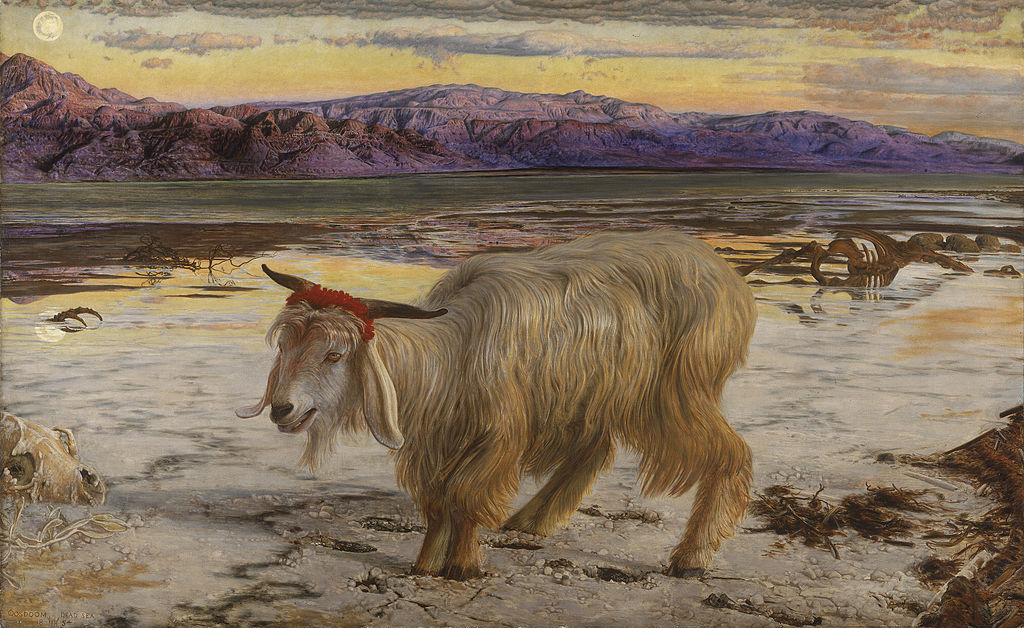
Scapegoat: In modern usage a
scapegoat is an individual, group, or country singled out for unmerited
negative treatment or blame. A whipping boy, "fall guy" or
"patsy" is a form of scapegoat.
Scapegoat derives from
the common English translation of the Hebrew term azazel (Hebrew: עזאזל) which
occurs in Leviticus 16:8 after the prefix la- (Hebrew לַ "for").
And Aaron shall place lots upon the two he
goats: one lot "For the Lord," and the other lot, "For
Azazel."
—Leviticus, Leviticus 16:8

Outlaw: In historical legal
systems, an outlaw is declared as outside the protection of the law. In
pre-modern societies, the criminal is withdrawn all legal protection, so that
anyone is legally empowered to persecute or kill them. Outlawry was thus one of
the harshest penalties in the legal system. In early Germanic law, the death
penalty is conspicuously absent, and outlawing is the most extreme punishment,
presumably amounting to a death sentence in practice. The concept is known from
Roman law, as the status of homo sacer, and persisted throughout the Middle
Ages.

The
Clash of Civilizations is a theory that people's cultural and religious
identities will be the primary source of conflict in the post-Cold War world.
It was proposed by political scientist Samuel P. Huntington in a 1992 lecture
at the American Enterprise Institute, which was then developed in a 1993
Foreign Affairs article titled "The Clash of Civilizations?", in response
to his former student Francis Fukuyama's 1992 book, The End of History and the
Last Man. Huntington later expanded his thesis in a 1996 book The Clash of
Civilizations and the Remaking of World Order.
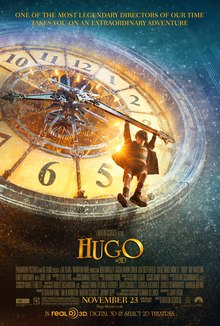
Hugo “Who am I? Where is my
place in the universe? If the whole world is a machine, where is my part that
function the world as it should be?”
A utopia /juːˈtoʊpiə/
is a community or society possessing highly desirable or near perfect
qualities. The word was coined by Sir Thomas More in Latin for his 1516 book
Utopia, describing a fictional island society in the Atlantic Ocean. The term
has been used to describe both intentional communities that attempt to create
an ideal society, and imagined societies portrayed in fiction. It has spawned
other concepts, most prominently dystopia.
A dystopia (from the
Greek δυσ- and τόπος, alternatively, cacotopia, kakotopia, cackotopia, or
anti-utopia) is a community or society that is in some important way
undesirable or frightening. It is the opposite of a utopia. Such societies
appear in many artistic works, particularly in stories set in a future.
Dystopias are often characterized by dehumanization, totalitarian governments,
environmental disaster, or other characteristics associated with a cataclysmic
decline in society. Dystopian societies appear in many sub-genres of fiction
and are often used to draw attention to real-world issues regarding society,
environment, politics, economics, religion, psychology, ethics, science, and/or
technology, which if unaddressed could potentially lead to such a dystopia-like
condition.
John Ronald Reuel
Tolkien, CBE (/ˈtɒlkiːn/ TOL-keen; 3 January 1892 – 2 September 1973) was an
English writer, poet, philologist, and university professor, best known as the
author of the classic high fantasy works The Hobbit, The Lord of the Rings, and
The Silmarillion.
He served as the
Rawlinson and Bosworth Professor of Anglo-Saxon and Fellow of Pembroke College,
Oxford, from 1925 to 1945 and Merton Professor of English Language and
Literature and Fellow of Merton College, Oxford from 1945 to 1959. He was at
one time a close friend of C. S. Lewis—they were both members of the informal
literary discussion group known as the Inklings. Tolkien was appointed a
Commander of the Order of the British Empire by Queen Elizabeth II on 28 March
1972.
After Tolkien's death,
his son Christopher published a series of works based on his father's extensive
notes and unpublished manuscripts, including The Silmarillion. These, together
with The Hobbit and The Lord of the Rings form a connected body of tales,
poems, fictional histories, invented languages, and literary essays about a
fantasy world called Arda, and Middle-earth within it. Between 1951 and 1955,
Tolkien applied the term legendarium to the larger part of these writings.
While many other authors had published works of fantasy before Tolkien, the
great success of The Hobbit and The Lord of the Rings led directly to a popular
resurgence of the genre. This has caused Tolkien to be popularly identified as
the "father" of modern fantasy literature—or, more precisely, of high
fantasy.
In 2008, The Times
ranked him sixth on a list of "The 50 greatest British writers since
1945". Forbes ranked him the 5th top-earning "dead celebrity" in
2009.
Ursula K. Le Guin: Ursula
Kroeber Le Guin (US /ˈɜrsələ ˈkroʊbər ləˈɡwɪn/; born October 21, 1929) is an
American author of novels, children's books, and short stories, mainly in the
genres of fantasy and science fiction. She has also written poetry and essays.
First published in the 1960s, her work has often depicted futuristic or
imaginary alternative worlds in politics, natural environment, gender,
religion, sexuality and ethnography.
Le Guin was influenced
by fantasy writers including J. R. R. Tolkien, by science fiction writers
including Philip K. Dick (who was in her same high school class, though they
didn't know one another), by central figures of Western literature such as Leo
Tolstoy, Virgil and the Brontë sisters, by feminist writers such as Virginia
Woolf, by children's literature such as Alice in Wonderland, The Wind in the
Willows, The Jungle Book, by Norse mythology, and by books from the Eastern
tradition such as the Tao Te Ching. In turn, she influenced such Booker Prize
winners and other writers, as Salman Rushdie and David Mitchell – and notable
futurism and fantasy writers including Neil Gaiman and Iain Banks. She has won
the Hugo Award, Nebula Award, Locus Award, and World Fantasy Award, each more
than once.
Keep/ make/ break the
promise
Kept woman 金屋藏嬌
1,娥苏拉·勒瑰恩(Ursula K. Le Guin)《地海传说》三部曲

包括《地海巫师》、《地海古墓》与《地海彼岸》(但全部系列共有6本,这是前三本)。叙述巫师「雀鹰」的三段成长冒险故事,透过奇幻世界丰富的象征性与想象空间,深入刻画自我成长的心理历程。
2,约翰·罗纳德·瑞尔·托尔金(John Ronald Reuel Tolkien)《魔戒》三部曲

包括《魔戒再现》、《双塔奇兵》与《王者无敌》。20世纪最流行的文学作品之一,无论从是销售量还是读者评价来讲。托尔金的重要影响在于,在《魔戒》成功之后,奇幻小说这一文学体裁迅速发展起来。
3,路易斯(C. S. Lewis)《纳尼亚传奇》系列

包括《狮子‧女巫‧魔衣橱》、《贾斯潘王子》、《黎明行者号》、《银椅》、《奇幻马和传说》、《魔法师的外甥》和《最后的战役》等作品。

Nineteen Eighty-Four,
sometimes published as 1984, is a dystopian novel by George Orwell published in
1949. The novel is set in Airstrip One (formerly known as Great Britain), a
province of the superstate Oceania in a world of perpetual war, omnipresent
government surveillance, and public manipulation, dictated by a political
system euphemistically named English Socialism (or Ingsoc in the government's
invented language, Newspeak) under the control of a privileged Inner Party
elite that persecutes all individualism and independent thinking as
"thoughtcrimes". The tyranny is epitomized by Big Brother, the
quasi-divine Party leader who enjoys an intense cult of personality, but who
may not even exist. Big Brother and the Party justify their oppressive rule in
the name of a supposed greater good. The protagonist of the novel, Winston
Smith, is a member of the Outer Party who works for the Ministry of Truth (or
Minitrue), which is responsible for propaganda and historical revisionism. His
job is to rewrite past newspaper articles so that the historical record always
supports the current party line. Smith is a diligent and skillful worker, but
he secretly hates the Party and dreams of rebellion against Big Brother.
As literary political
fiction and dystopian science-fiction, Nineteen Eighty-Four is a classic novel
in content, plot, and style. Many of its terms and concepts, such as Big
Brother, doublethink, thoughtcrime, Newspeak, Room 101, Telescreen, 2 + 2 = 5,
and memory hole, have entered everyday use since its publication in 1949.
Moreover, Nineteen Eighty-Four popularised the adjective Orwellian, which describes
official deception, secret surveillance, and manipulation of the past by a
totalitarian or authoritarian state. In 2005, the novel was chosen by TIME
magazine as one of the 100 best English-language novels from 1923 to 2005. It
was awarded a place on both lists of Modern Library 100 Best Novels, reaching
number 13 on the editor's list, and 6 on the readers' list. In 2003, the novel
was listed at number 8 on the BBC's survey The Big Read.
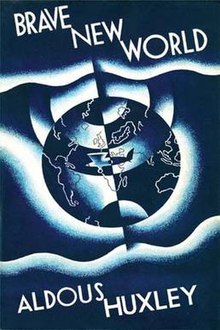
Brave New World is a
novel written in 1931 by Aldous Huxley and published in 1932. Set in London of
AD 2540 (632 A.F.—"After Ford"—in the book), the novel anticipates
developments in reproductive technology, sleep-learning, psychological
manipulation, and classical conditioning that combine to profoundly change
society. Huxley answered this book with a reassessment in an essay, Brave New
World Revisited (1958), and with Island (1962), his final novel.
In 1999, the Modern
Library ranked Brave New World fifth on its list of the 100 best
English-language novels of the 20th century. In 2003, Robert McCrum writing for
The Observer listed Brave New World number 53 in "the top 100 greatest
novels of all time", and the novel was listed at number 87 on the BBC's
survey The Big Read.

The Island
(film)
It is described as a
pastiche of "escape-from-dystopia" science fiction films of the 1960s
and 1970s such as Fahrenheit 451, THX 1138, Parts: The Clonus Horror, and
Logan's Run. The film's plot revolves around the struggle of Ewan McGregor's
character to fit into the highly structured world he lives in, isolated in a
compound, and the series of events that unfold when he questions how truthful
that world really is. After he learns that the compound inhabitants are clones
who are used for organ harvesting and surrogate motherhood for wealthy people
in the outside world, he escapes.
The film cost $126
million to produce. It earned only $36 million at the United States box office,
but earned $127 million overseas, for a $162 million worldwide total. The
original score for the film was composed by Steve Jablonsky. It was also the
first film directed by Michael Bay that was not produced by Jerry Bruckheimer.

The Tempest is a play
by William Shakespeare, believed to have been written in 1610–11, and thought
by many critics to be the last play that Shakespeare wrote alone. It is set on
a remote island, where Prospero, the rightful Duke of Milan, plots to restore
his daughter Miranda to her rightful place using illusion and skillful
manipulation. He conjures up a storm, the eponymous tempest, to lure his
usurping brother Antonio and the complicit King Alonso of Naples to the island.
There, his machinations bring about the revelation of Antonio's lowly nature,
the redemption of the King, and the marriage of Miranda to Alonso's son,
Ferdinand.

In the Bible, the wife
of Lot is a figure first mentioned in Genesis 19. The Book of Genesis describes
how she became a pillar of salt after she looked back at Sodom. She is called
"Ado" or Ildith or "Edith" in some Jewish traditions, but
is not named in the Bible. She is also referred to in the New Testament at Luke
17:32
The Island is a 2005
American science fiction/thriller film directed by Michael Bay, starring Ewan
McGregor and Scarlett Johansson. It was released on July 22, 2005, in the
United States, and was nominated for three awards, including the Teen Choice
Award.
Comments
Post a Comment