Week 3: notes_ chapter 1 & 2 (etymology)
Week 3
|
|
Learning word parts form context clues
|
|
1.
-ary
|
It stands for adjective
suffix
e.g. customary, boundary |
2.
il, im, in, ir
|
They change a word to its opposite meaning
e.g. illegal, immobile, inconspicuous, irrelevant
|
dismiss
|
Release/ ignore
|
3.
de-
|
Move away from
e.g. depreciate, decomposition (composi-: 合在一起)
|
In grammar, an
interjection or exclamation may be a word used to express an emotion or
sentiment on the part of the speaker (although most interjections have clear
definitions). Filled pauses such as uh,
er, um are also considered interjections. Interjections are often placed
at the beginning of a sentence.
|
|
De-: down, away from
|
e.g. depreciate, decline, depature
|
Incongruous: not logically related to
|
Con-: together, with
|
Hedonist (negative)
|
Indulge too much in fun
|
Flunk out
|
It means getting an
F.
|
Reach a reconciliation
|
Reconcile (verb)
|
Ex-: out of
|
Extricate from
|
Se-: apart from, away from
|
e.g. separate, seclude, select
|
Inflammation
|
Itis-: disease
e.g. bronchitis,
gastritis
|
Old high school flames
|
舊愛
|
Meander around
|
Go meandering
through
|
Wander/ ramble/ meander
|
wander means to walk slowly in a place
ramble means to walk for pleasure
Meander suggests leisurely wandering over an
irregular or winding course
an irregular or winding course:
To walk aimlessly. To walk without any clear
direction.
One hasn't started to go to a particular place.
Any bird in the tree or a flower in the field is
able to change his route.
|
Feud
|
吵架
|
Was meandering home from
|
Extricate herself from
|
Be unethical of
|
Be incongruous of
|
Predicament
|
Difficulty
|
Bring oneself tremendous relief
|
|
Advice
|
A noun meaning a suggestion or an opinion
|
Advise
|
A verb meaning to
provide suggestions
|
Week 3
| |
Oral epic/ epic poetry
|
An epic (from the Ancient Greek adjective ἐπικός (epikos), from ἔπος (epos) "word, story, poem") is a lengthy narrative poem, ordinarily concerning a serious subject containing details of heroic deeds and events significant to a culture or nation.
Oral poetry may qualify as an epic, and Albert Lord and Milman Parry have argued that classical epics were fundamentally an oral poetic form. Another type of epic poetry is epyllion (plural: epyllia), which is a brief narrative poem with a romantic or mythological theme. The term, which means 'little epic', came into use in the nineteenth century. It refers primarily to the erudite, shorter hexameter poems of the Hellenistic period and the similar works composed at Rome from the age of the neoterics; to a lesser degree, the term includes some poems of the English Renaissance, particularly those influenced by Ovid.[citation needed] The most famous example of classical epyllion is perhaps Catullus 64. |
Beowulf
| |
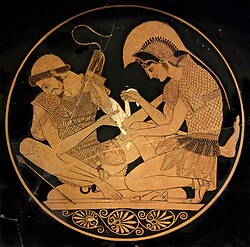
The Iliad (sometimes referred to as the Song of Ilion or Song of Ilium) is an ancient Greek epic poem in dactylic hexameter, traditionally attributed to Homer. Set during the Trojan War, the ten-year siege of the city of Troy (Ilium) by a coalition of Greek states, it tells of the battles and events during the weeks of a quarrel between King Agamemnon and the warrior Achilles.
| |
The Odyssey (Greek: Ὀδύσσεια, Odýsseia) is one of two major ancient Greek epic poems attributed to Homer. It is, in part, a sequel to the Iliad, the other work ascribed to Homer. The poem is fundamental to the modern Western canon, and is the second oldest extant work of Western literature, the Iliad being the oldest. It is believed to have been composed near the end of the 8th century BC, somewhere in Ionia, the Greek coastal region of Anatolia.
| |
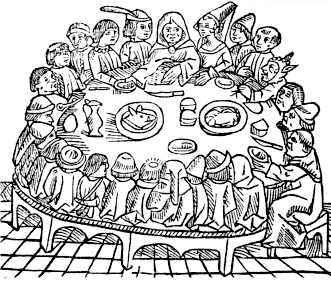
The Canterbury Tales is a collection of stories written in Middle English by Geoffrey Chaucer at the end of the 14th century, during the time of the Hundred Years' War. The tales (mostly written in verse, although some are in prose) are presented as part of a story-telling contest by a group of pilgrims as they travel together on a journey from Southwark to the shrine of Saint Thomas Becket at Canterbury Cathedral. The prize for this contest is a free meal at the Tabard Inn at Southwark on their return.
Frame works/ story within story
| |
“bury”
|
祖先埋鍋造飯之處
|
“shire”
|
人類群居的人文遺居
|
English grammar was mostly Anglo- Saxon, until William the Conqueror it changed.
| |
Millere
|
粗俗
|



Comments
Post a Comment