Week 8
Continue Poe’s poetry and criticism: “The Philosophy of Composition,” “The Raven,” “To Helen,” “Annabel Lee”

Young Goodman Brown
"Young Goodman Brown" is a short story published in 1835 by American writer Nathaniel Hawthorne. The story takes place in 17th century Puritan New England, a common setting for Hawthorne's works, and addresses the Calvinist/Puritan belief that all of humanity exists in a state of depravity, except those who are born in a state of grace. Hawthorne frequently attempts to expose the hypocrisy of Puritan culture in his literature. In a symbolic fashion, the story follows Young Goodman Brown's journey into self-scrutiny, which results in his loss of virtue and belief.
Allegory

hear (someone or something) without meaning to or without the knowledge of the speaker.



Young Goodman Brown
"Young Goodman Brown" is a short story published in 1835 by American writer Nathaniel Hawthorne. The story takes place in 17th century Puritan New England, a common setting for Hawthorne's works, and addresses the Calvinist/Puritan belief that all of humanity exists in a state of depravity, except those who are born in a state of grace. Hawthorne frequently attempts to expose the hypocrisy of Puritan culture in his literature. In a symbolic fashion, the story follows Young Goodman Brown's journey into self-scrutiny, which results in his loss of virtue and belief.
Allegory
As a literary device, an allegory in its most general sense is an extended metaphor. Allegory has been used widely throughout history in all forms of art, largely because it can readily illustrate complex ideas and concepts in ways that are comprehensible or striking to its viewers, readers, or listeners.
Writers or speakers typically use allegories as literary devices or as rhetorical devices that convey hidden meanings through symbolic figures, actions, imagery, and/or events, which together create the moral, spiritual, or political meaning the author wishes to convey.[1]
One of the best-known examples of allegory, Plato's Allegory of the Cave, forms a part of his larger work The Republic. In this allegory, Plato describes a group of people who have lived chained in a cave all of their lives, facing a blank wall (514a-b). The people watch shadows projected on the wall by things passing in front of a fire behind them and begin to ascribe forms to these shadows, using language to identify their world (514c-515a). According to the allegory, the shadows are as close as the prisoners get to viewing reality, until one of them finds his way into the outside world where he sees the actual objects that produced the shadows. He tries to tell the people in the cave of his discovery, but they do not believe him and vehemently resist his efforts to free them so they can see for themselves (516e-518a). This allegory is, on a basic level, about a philosopher who upon finding greater knowledge outside the cave of human understanding, seeks to share it as is his duty, and the foolishness of those who would ignore him because they think themselves educated enough.[2]
Overhear
"I couldn't help overhearing your conversation"
"The Fall of the House of Usher" is a short story by Edgar Allan Poe first published in 1839.
Bosom friend: A very close friend
讀完文本,才不會見樹不見林。
Fable is a literary genre: a succinct fictional story, in prose or verse, that features animals, mythical creatures, plants, inanimate objects, or forces of nature that are anthropomorphized (given human qualities, such as verbal communication) and that illustrates or leads to an interpretation of a moral lesson (a "moral"), which may at the end be added explicitly as a pithy maxim.
A fable differs from a parable in that the latter excludes animals, plants, inanimate objects, and forces of nature as actors that assume speech or other powers of humankind.
Usage has not always been so clearly distinguished. In the King James Version of the New Testament, "μῦθος" ("mythos") was rendered by the translators as "fable"[1] in the First Epistle to Timothy, the Second Epistle to Timothy, the Epistle to Titus and theFirst Epistle of Peter.[2]
A person who writes fables is a fabulist.
A parable is a succinct, didactic story, in prose or verse, which illustrates one or more instructive lessons or principles. It differs from afable in that fables employ animals, plants, inanimate objects, or forces of nature as characters, whereas parables have human characters.[1] A parable is a type of analogy.[2]
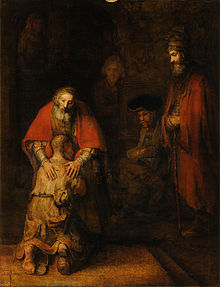
Some scholars of the canonical gospels and the New Testament apply the term "parable" only to the parables of Jesus,[3][4] though that is not a common restriction of the term. Parables such as "The Prodigal Son" are central to Jesus' teaching method in the canonical narratives and the apocrypha.
Orpheus (/ˈɔrfiəs, ˈɔrfjuːs/; Greek: Ὀρφεύς) was a legendary Thracian musician, poet, and prophet in ancient Greek religionand myth. The major stories about him are centered on his ability to charm all living things and even stones with his music, his attempt to retrieve his wife, Eurydice, from the underworld, and his death at the hands of those who could not hear his divine music. As an archetype of the inspired singer, Orpheus is one of the most significant figures in the reception of classical mythology in Western culture, portrayed or alluded to in countless forms of art and popular culture including poetry, film, opera, music, and painting.[1]
For the Greeks, Orpheus was a founder and prophet of the so-called "Orphic" mysteries. He was credited with the composition of the Orphic Hymns, a collection of which survives.[2] Shrines containing purported relics of Orpheus were regarded as oracles. Some ancient Greek sources note Orpheus' Thracian origins.[3]
Ribbon
A ribbon or riband is a thin band of material, typically cloth but also plastic or sometimes metal, used primarily as decorative binding and tying.[1] Cloth ribbons are made of natural materials such as silk, velvet, cotton, and jute and of synthetic materials, such as polyester, nylon and polyproylene. Ribbon is used for innumerable useful, ornamental and symbolic purposes. Cultures around the world use ribbon in their hair, around the body, and as ornamentation on animals, buildings, and packaging. Some popular fabrics used to make ribbons are satin, organza, sheer, silk, velvet and grosgrain.
Etymology
The word ribbon comes from Middle English ribban or riban from Old French ruban, which is probably of Germanic origin.[1]
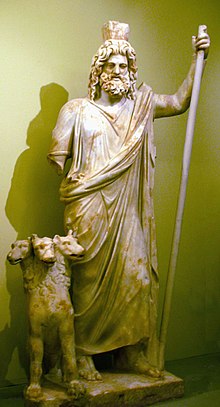
Hades (/ˈheɪdiːz/; Ancient Greek: ᾍδης or Άͅδης, Háidēs) was the ancient Greek chthonic god of the underworld, which eventually took his name.[1]
In Greek mythology, Hades was regarded as the oldest son of Cronus and Rhea, although the last son regurgitated by his father.[n 1]He and his brothers Zeus and Poseidon defeated their father's generation of gods, the Titans, and claimed rulership over thecosmos. Hades received the underworld, Zeus the air, and Poseidon the sea, with the solid earth—long the province of Gaia—available to all three concurrently. Hades was often portrayed with his three-headed guard dog Cerberus and, in later mythological authors, associated with the Helm of Darkness and the bident.
The Etruscan god Aita and Roman gods Dis Pater and Orcus were eventually taken as equivalent to the Greek Hades and merged as Pluto, a latinization of his euphemistic Greek name Plouton.[3]
You are so in Vain
Let the River Run
Comments
Post a Comment