Week 3
1812-1865 Inferiority Complex
Def.: an unrealistic feeling of general inadequacy caused by actual or supposed inferiority in one sphere, sometimes marked by aggressive behavior in compensation.
An inferiority complex is a lack of self-worth, a doubt and uncertainty, and feelings of not measuring up to standards. It is often subconscious, and is thought to drive afflicted individuals to overcompensate, resulting either in spectacular achievement or extreme asocial behavior. In modern literature, the preferred terminology is "lack of covert self-esteem".[1] For many, it is developed through a combination of genetic personality characteristics and personal experiences.
Tran-: across
MRT: Metro Railway Transportation
Transcendentalism
Tran-: across
MRT: Metro Railway Transportation
Transcendentalism
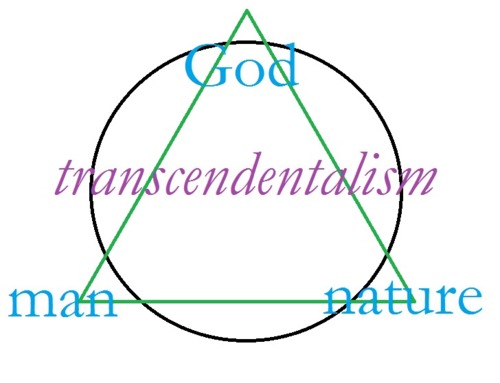
Transcendentalism was a philosophical movement that developed in the late 1820s and 1830s in the eastern region of the United States. The movement was a reaction to, or protest against the general state of intellectualism and spirituality.[1] The doctrine of theUnitarian church as taught at Harvard Divinity School was of particular interest.
Transcendentalism was rooted in English and German Romanticism, the Biblical criticism of Herder and Schleiermacher, the skepticism of Hume,[2] and the transcendental philosophy of Immanuel Kant and of German Idealism. It was also influenced byIndian religions, especially the Upanishads.
A core belief was in the inherent goodness of both people and nature. They believed that society and its institutions ultimately corrupted the purity of the individual, and had faith that people are at their best when truly "self-reliant" and independent.
Their intellectual preoccupations were less reliant on objective empiricism, and more on subjective intuition. They believed that individuals were capable of generating completely original insights with as little attention and deference to past masters as possible.


Anne Bradstreet (born Anne Dudley; March 20, 1612 – September 16, 1672) was the most prominent of early English poets of North America and first female writer in the British North American colonies to be published. She was also a prominent Puritan figure in American Literature. Her first volume of poetry was The Tenth Muse Lately Sprung Up in America, published in 1650. It was met with a positive reception in both the Old World and the New World.[1][2]
The Mathers were a singularly provocative family, capable, ambitious, certain to have a finger in every pie baking in the theocratic oven. From the emigrant Richard with the great voice, chief architect of the Cambridge Platform, to the provincial Cotton, the family combativeness and love of publicity put their marks on New England history. Of the three generations, certainly Increase Mather was the most generously endowed with capacity for leadership; an able man, practical and assertive, liking to be in the forefront of affairs, not wanting his light hidden under a bushel. An arch-conservative, he justified his ways to his conscience by the excellence of the heritage he strove to conserve. A formalist, he satisfied his intellectual curiosity by extolling the sufficiency of the creed of the fathers. He closed the windows of his mind against the winds of new doctrine, and bounded the fields of speculative inquiry by orthodox fences. He was of the succession of John Cotton rather than Thomas Hooker, a priestly theocrat, though never a shuffler like Cotton, less troubled by free inquiry, less by the intellectual. All his life he was inhibited from bold speculation by his personal loyalties and interests. As a beneficiary of things as they were, certain to lose in prestige and power with any relaxing of the theocracy, it would be asking too much of human nature to expect him to question the sufficiency of the established system of which he was the most distinguished representative. Not to have approved it would have been to repudiate his habitual way of thinking, his deepest prejudices, his strongest convictions. He had been molded and shaped by the theocracy; it was the very marrow of his bones; as well demand that pig iron turn molten again after it comes from the matrix. The ore of which he was fashioned was excellent, but once molded it was rigid; there would be no return to fluidity. And so determined by every impact of environment, by every appeal of loyalty, and by a very natural ambition, Increase Mather became a stout upholder of the traditional order, a staunch old Puritan Tory of the theocratic line. How could any promptings of liberalism find nourishment in such a mind?2 Why should one expect to find in the works of such a man the seeds of new systems of thought or more generous institutions? He was the outstanding figure of the theocracy in the days of its overthrow, but intellectually he was not worthy to unloose the shoestrings of Roger Williams.
Subjectivity is a central philosophical concept, related to consciousness, agency, personhood, reality, and truth, which has been variously defined by sources. Three common definitions include that subjectivity is the quality or condition of:
- Something being a subject, narrowly meaning an individual who possesses conscious experiences, such as perspectives, feelings, beliefs, and desires.[1]
- Something being a subject, broadly meaning an entity that has agency, meaning that it acts upon or wields power over some other entity (an object).
- Some information, idea, situation, or physical thing considered true only from the perspective of a subject or subjects.
These various definitions of subjectivity are sometimes joined together in philosophy. The term is most commonly used as an explanation for that which influences, informs, and biases people's judgments about truth or reality; it is the collection of the perceptions, experiences, expectations, personal or cultural understanding, and beliefs specific to a person. It is often used in contrast to the term objectivity,[1] which is described as a view of truth or reality which is free of any individual's influence.
Thou 主格
Thee 受格
Thy 所有格
Nickname has no logic.
Offspring: 後代
Pentameter (from Greek: πεντάμετρος - 'measuring five (feet)') is a poetic meter. А poem is said to be written in (a particular) pentameter when the lines of the poem have the length of five feet, where 'foot' is a combination of a particular number (1 or 2) of unstressed (or weak) syllables and a stressed (or strong) syllable. Depending on the pattern of feet, pentameter can be iambic (one of three two-syllable meters alongside trochaic and spondaic) or dactylic (one of two three-syllable meters alongside anapestic) (see links below).
This class of meters includes:
- the dactylic pentameter of antiquity
- the iambic pentameter of the modern period
The Author to Her Book
Thou ill-form’d offspring of my feeble brain,
Who after birth didst by my side remain,
Till snatched from thence by friends, less wise than true,
Who thee abroad, expos’d to publick view,
Made thee in raggs, halting to th’ press to trudge,
Where errors were not lessened (all may judg).
At thy return my blushing was not small,
My rambling brat (in print) should mother call,
I cast thee by as one unfit for light,
Thy Visage was so irksome in my sight;
Yet being mine own, at length affection would
Thy blemishes amend, if so I could:
I wash’d thy face, but more defects I saw,
And rubbing off a spot, still made a flaw.
I stretched thy joynts to make thee even feet,
Yet still thou run’st more hobling then is meet;
In better dress to trim thee was my mind,
But nought save home-spun Cloth, i’ th’ house I find.
In this array ’mongst Vulgars mayst thou roam.
In Criticks hands, beware thou dost not come;
And take thy way where yet thou art not known,
If for thy Father askt, say, thou hadst none:
And for thy Mother, she alas is poor,
Which caus’d her thus to send thee out of door.
Brat: The term "brat" derives from an Old English (Old English) slang term meaning "beggar's child".
Artistic license (also known as art licenselo, historical license, dramatic license, poetic license, narrative license, licentia poetica, or simply license) is a colloquial term, sometimes a euphemism, used to denote the distortion of fact, alteration of the conventions of grammar or language, or rewording of pre-existing text made by an artist in the name of art.
Comments
Post a Comment