Week 6 Edgar Allan Poe’s “The Tell-Tale Heart”
Week
6 Edgar Allan Poe’s “The Tell-Tale Heart”
|
Recite
|
Recitation
|
|
The repetition of the same
sounds or of the same kinds of sounds at the beginning of words or in
stressed syllables of an English language phrase.
|
|
|
|
Alliteration
developed largely through poetry, in which it more narrowly refers to the
repetition of a consonant in any syllables that, according to the poem's
meter, are stressed, as in James Thomson's verse "Come…dragging the lazy
languid Line along". Another example is Peter Piper Picked a Peck of
Pickled Peppers.
|
|
|
There is one specialised form
of alliteration called Symmetrical Alliteration. That is, alliteration
containing parallelism.[7] In this case, the phrase must be constituted of
two end words both starting with the same letter, and the pairs of outside
words getting progressively closer to the centre of the phrase also starting
with identical letters. For example, "rust brown blazers rule",
"purely and fundamentally for analytical purposes" or "fluoro
colour co-ordination forever". Symmetrical alliteration is similar to
palindromes in its usage of symmetry.
|
|
Consonance
is a poetic device characterized by the repetition of the same consonant two
or more times in short succession, as in "pitter patter" or in
"all mammals named Sam are clammy".
|
|
|
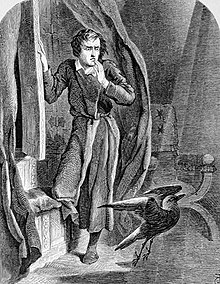
is a narrative poem by American
writer Edgar Allan Poe. First published in January 1845, the poem is often
noted for its musicality, stylized language, and supernatural atmosphere. It
tells of a talking raven's mysterious visit to a distraught lover, tracing
the man's slow fall into madness. The lover, often identified as being a
student, is lamenting the loss of his love, Lenore. Sitting on a bust of
Pallas, the raven seems to further instigate his distress with its constant
repetition of the word "Nevermore". The poem makes use of a number
of folk and classical references.
|
|
|
Once upon a midnight
dreary, while I pondered, weak and weary,
Over many a quaint and
curious volume of forgotten lore—
While I nodded, nearly
napping, suddenly there came a tapping,
As of some one gently
rapping, rapping at my chamber door.
"'Tis some
visiter," I muttered, "tapping at my chamber door—
Only this and nothing more."… (more)
|
|
|
A word that phonetically
imitates, resembles or suggests the source of the sound that it describes.
Onomatopoeia (as an uncountable noun) refers to the property of such words.
Common occurrences of onomatopoeias include animal noises such as
"oink", "meow", "roar" or "chirp".
Onomatopoeias are not the same across all languages; they conform to some
extent to the broader linguistic system they are part of; hence the sound of
a clock may be tick tock in English, dī dā in Mandarin, or katchin katchin in
Japanese.
|
|
|
|
Although
in the English language the term onomatopoeia means the imitation of a sound,
in the Greek language the compound word onomatopoeia (ονοματοποιία) means
"making or creating names".
For words that imitate sounds the term Ηχομιμητικό (echomimetico or
echomimetic) is used. Ηχομιμητικό (echomimetico) from Ηχώ meaning "echo
or sound" and μιμητικό meaning "mimetic or imitation".
|
|
The Philosophy of Composition
(Wikisource has original text
related to this article:
|
An 1846 essay written by
American writer Edgar Allan Poe that elucidates a theory about how good
writers write when they write well. He concludes that length, "unity of
effect" and a logical method are important considerations for good
writing. He also makes the assertion that "the death... of a beautiful
woman" is "unquestionably the most poetical topic in the
world". Poe uses the composition of his own poem "The Raven"
as an example. The essay first appeared in the April 1846 issue of Graham's
Magazine. It is uncertain if it is an authentic portrayal of Poe's own
method.
|
|
Edgar
Allan Poe (born Edgar Poe; January 19, 1809 – October 7, 1849) was an American
author, poet, editor, and literary critic, considered part of the American
Romantic Movement. Best known for his tales of mystery and the macabre, Poe
was one of the earliest American practitioners of the short story, and is
generally considered the inventor of the detective fiction genre. He is
further credited with contributing to the emerging genre of science fiction.
He was the first well-known American writer to try to earn a living through
writing alone, resulting in a financially difficult life and career.
|
|
|
Ode to the West Wind is an ode
written by Percy Bysshe Shelley in 1819 near Florence, Italy. It was
published in 1820 by Charles and James Ollier in London as part of the
collection Prometheus Unbound, A Lyrical Drama in Four Acts, With Other
Poems.
|
|
|
IV.
If I were a dead leaf
thou mightest bear;
If I were a swift cloud
to fly with thee;
A wave to pant beneath
thy power, and share
The impulse of thy
strength, only less free
Than thou, O,
uncontroulable! If even
I were as in my boyhood,
and could be
The comrade of thy
wanderings over heaven,
As then, when to
outstrip thy skiey speed
Scarce seemed a vision;
I would ne'er have striven
As thus with thee in
prayer in my sore need.
Oh! lift me as a wave, a
leaf, a cloud!
I fall upon the thorns of life!
I bleed!
A heavy weight of hours
has chained and bowed
One too like thee:
tameless, and swift, and proud.
|
V.
Make
me thy lyre, even as the forest is:
What
if my leaves are falling like its own!
The
tumult of thy mighty harmonies
Will
take from both a deep, autumnal tone,
Sweet
though in sadness. Be thou, spirit fierce,
My
spirit! Be thou me, impetuous one!
Drive
my dead thoughts over the universe
Like
withered leaves to quicken a new birth!
And,
by the incantation of this verse,
Scatter,
as from an unextinguished hearth
Ashes
and sparks, my words among mankind!
Be
through my lips to unawakened earth
The
trumpet of a prophecy! O, wind,
If Winter comes, can Spring be
far behind?
|
|
"Bartleby, the Scrivener:
A Story of Wall Street" is a short story by the American writer Herman Melville
(1819–1891). It first appeared anonymously in two parts in the November and
December 1853 editions of Putnam's Magazine, and was reprinted with minor
textual alterations in his The Piazza Tales in 1856.
|
|
|
The
parable of the Good Samaritan is a parable told by Jesus and is mentioned in
only one of the gospels of the New Testament. According to the Gospel of Luke
(10:29–37) a traveller (who may or may not be Jewish) is beaten, robbed, and
left half dead along the road. First a priest and then a Levite come by, but
both avoid the man. Finally, a Samaritan comes by. Samaritans and Jews
generally despised each other, but the Samaritan helps the injured man. Jesus
is described as telling the parable in response to a question regarding the
identity of the "neighbour", who Leviticus 19:18 says should be
loved.
|
|
|
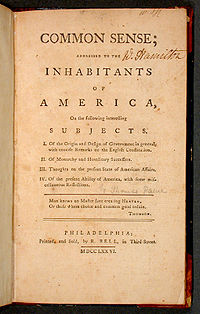
Common Sense is a pamphlet
written by Thomas Paine
in 1775–76 that inspired people in the Thirteen Colonies to declare and fight
for independence from Great Britain in the summer of 1776. In clear, simple
language it explained the advantages of and the need for immediate
independence. It was published anonymously on January 10, 1776, at the
beginning of the American
Revolution and became an immediate sensation. It was sold and distributed
widely and read aloud at taverns and meeting places. Washington had it read
to all his troops, which at the time had surrounded the British army in
Boston. In proportion to the population of the colonies at that time (2.5
million), it had the largest sale and circulation of any book published in
American history.
|
|
|
A
polymath (Greek: πολυμαθής, polymathēs, "having learned much") is a
person whose expertise spans a significant number of different subject areas;
such a person is known to draw on complex bodies of knowledge to solve
specific problems. The term was first used in the seventeenth century but the
related term, polyhistor, is an ancient term with similar meaning.
|
|
|
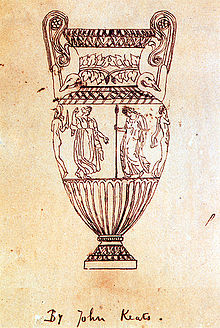
"Ode on a Grecian
Urn" is a poem written by the English Romantic poet John Keats in May
1819 and published anonymously in the January 1820, Number 15 issue of the
magazine Annals of the Fine Arts.
|
|
|
5.
O Attic shape! Fair
attitude! with brede
Of marble men and maidens overwrought,
With forest branches and
the trodden weed;
Thou, silent form, dost tease us out of thought
As doth eternity: Cold
Pastoral!
When old age shall this generation waste,
Thou shalt remain, in midst of other woe
Than ours, a friend to
man, to whom thou say'st,
"Beauty is truth, truth
beauty,"—that is all
Ye know on earth, and all ye need to know.
|
|
|
Pallas Athena
|
Phoebus Apollo
|
|
a
Japanese author, poet, playwright, actor, and film director. Mishima is
considered one of the most important Japanese authors of the 20th century; he
was nominated three times for the Nobel Prize in Literature and was poised to
win the prize in 1968 although lost the award to his fellow countryman
Yasunari Kawabata, presumably because of his radical right-wing activities. His
avant-garde work displayed a blending of modern and traditional aesthetics
that broke cultural boundaries, with a focus on sexuality, death, and
political change. He is also remembered for his ritual suicide by seppuku
after a failed coup d'état attempt, known as the "Mishima
Incident".
|
|
|
A Japanese short story writer
and novelist whose spare, lyrical, subtly-shaded prose works won him the
Nobel Prize for Literature in 1968, the first Japanese author to receive the
award. His works have enjoyed broad international appeal and are still widely
read.
|
|
|
An
American author, poet, editor, and literary critic, considered part of the
American Romantic Movement. Best known for his tales of mystery and the
macabre, Poe was one of the earliest American practitioners of the short
story, and is generally considered the inventor of the detective fiction
genre. He is further credited with contributing to the emerging genre of
science fiction. He was the first well-known American writer to try to earn a
living through writing alone, resulting in a financially difficult life and
career.
|
|


Comments
Post a Comment