Week 13: notes_ Folklore, Myth, and Legend (children literature)
|
Week 13
|
Folklore, Myth, and Legend
|
|
|
Narrative animal tale, anthromorphized, succinct
|
||
|
“If you can rock them, you can teach them.”
|
||
|
|
Moral Lesson stands for what you have learned and
what you have encountered right.
Moral lessons are things that you learn through
literature.
Considering you are reading Snow White, you will
find that there is something you learn from the story of snow white. In
'Little Red Riding Hood' the moral lesson is not to talk to strangers, or go
out alone. In 'Peter Pan' it is to never lose your sense of imagination.
Moral lessons someway impact your moral code. They teach you right from
wrong.
|
|
|
A parable is a succinct, didactic story, in prose or verse, which illustrates one or more
instructive lessons or principles. It differs from a fable in that fables employ animals,
plants, inanimate objects, or forces of nature as characters, whereas parables
have human characters. A parable is a type of analogy.
Some scholars of the canonical
gospels and the New Testament apply the term
"parable" only to the parables of
Jesus, though that is not a common restriction of the term.
Parables such as "The
Prodigal Son" are central to Jesus' teaching method in both
the canonical
narratives and the apocrypha.
|
||
|
Thistle is the common name of a group of flowering plants characterised by leaves with sharp prickles on the margins, mostly in
the family Asteraceae.
Prickles often occur all over the plant – on surfaces such as those of the
stem and flat parts of leaves. These are an adaptation that protects the plant
against herbivorous animals,
discouraging them from feeding on the plant. Typically, aninvolucre with a clasping shape of
a cup or urn subtends each of a thistle's flowerheads.
The term thistle is sometimes
taken to mean exactly those plants in the tribe Cynareae (synonym: Cardueae), especially
the genera Carduus, Cirsium, and Onopordum. However, plants outside this
tribe are sometimes called thistles, and if this is done thistles would form
a polyphyletic group.
Thistle is the floral emblem of Scotland.
|
||
|
Ass
|
笨蛋
|
|
|
Moral
|
後加的詮釋/ 各花入人眼
|
|
|
Enter into reflection
|
|
|
|
Prickly
|
having many sharp
points
caused or seeming to
be caused by something that has many small, sharp points
causing a prickly
feeling on your skin
|
|
|
Savory
|
having a pleasant taste or smell
having a spicy or salty quality without being
sweet
|
|
|
Be content with
|
|
|
|
John Denver
|
||
|
Be at his old tricks
|
故技重施
|
|
|
Tend to his cost
|
|
|
|
Call the meeting/ assembly
|
|
|
|
Distrust interested advice
|
|
|
|
Stump
|
樹根
|
|
|
Bolder face
|
大膽. 厚臉皮
|
|
|
Summon to a general meeting
|
|
|
|
Place before them
|
|
|
|
Assemble together
|
|
|
|
"Beauty and the Beast" (French: La Belle et la Bête)
is a traditional fairy tale.
The first published version was a rendition byGabrielle-Suzanne Barbot de Villeneuve, published in La
jeune américaine, et les contes marins in 1740. The best-known
written version was an abridgement of her work published in 1756 by Jeanne-Marie Le Prince de Beaumont, in Magasin des
enfants, ou dialogues entre une sage gouvernante et plusieurs de ses élèves;
an English translation appeared in 1757.
Variants of the tale are known
across Europe. In France, for example, Zémire et Azor is an operatic
version of the story, written byMarmontel and
composed by Grétry in 1771,
which had enormous success well into the 19th century; it is based on
the second version of the tale. Amour pour amour, by Nivelle de la
Chaussée, is a 1742 play based on Villeneuve's version.
|
||
|
以正面句子表達負面意義
|
Fail to see any
advantage
|
|
|
Though you be swift as the wind
|
I’ll beat you in a race/ slow but steady
|
|
|
Native swiftness
|
“Care little about
the race”
|
|
|
“The Hare, trusting to his native swiftness,
cared little about the race, and lying down by the wayside, feel fast asleep.”
|
龜兔賽跑
Perseverance is better than swiftness.
|
|
|
A flock of sheep
|
Keep eyes on/ let
them out of his sight/ slaughter
|
|
|
Trust my sheep to a wolf
|
所託非人
|
|
|
The Boy Who Cried Wolf is one of Aesop's Fables, numbered 210 in the Perry Index. From it is derived the English idiom "to cry
wolf", meaning to give a false alarm.
|
||
|
"Peter Peter Pumpkin Eater" is an English language nursery rhyme. It has a Roud Folk Song
Index number of
13497.
|
Peter, Peter pumpkin eater,
Had a wife but couldn't keep her;
He put her in a pumpkin shell
And there he kept her very well.
Peter, Peter pumpkin eater,
Had another and didn't love her;
Peter learned to read and spell,
And then he loved her very well.
|
|
|
Mary Had a Little Lamb is an English language nursery rhyme of nineteenth-century American origin. It has a Roud Folk Song
Index number of
7622.
|
Mary had a little
lamb,
whose fleece was
white as snow.
And everywhere that
Mary went,
the lamb was sure to
go.
It followed her to
school one day
which was against
the rule.
It made the children
laugh and play,
to see a lamb at
school.
And so the teacher
turned it out,
but still it
lingered near,
And waited patiently
about,
till Mary did
appear.
"Why does the
lamb love Mary so?"
the eager children
cry.
"Why, Mary
loves the lamb, you know."
the teacher did reply.
From Wikipedia, the
free encyclopedia
|
|
|
Peter Piper is an English-language nursery rhyme and well-known tongue-twister. It has a Roud Folk Song
Index number of
19745.
|
Peter Piper picked a peck of pickled peppers.
A peck of pickled peppers Peter Piper picked.
If Peter Piper picked a peck of pickled peppers,
Where's the peck of pickled peppers that Peter
Piper picked?
|
|
|
Jack and Jill (sometimes
"Jack and Gill", particularly in earlier versions) is a traditional
English nursery rhyme. The Roud Folk Song Index classifies this tune and its
variations as number 10266. The rhyme dates back at least to the 18th century
and exists with different numbers of verses each with a number of variations.
Several theories have been advanced to explain its origins and to suggest
meanings for the lyrics.
|
The first and most
commonly repeated verse is:
Jack and Jill went
up the hill
To fetch a pail of
water.
Jack fell down and
broke his crown,
And Jill came
tumbling after.
|
|
|
"There Was an Old Woman Who Lived in a Shoe"
is a popular English language nursery rhyme, with a Roud Folk Song
Index number of 19132. Debates over its meaning and origin have largely
centered on attempts to match the old woman with historical female figures
who have had large families, although King George II (1683–1760) has also
been proposed as the rhyme's subject.
|
The most common version of the rhyme is:
There was an old woman who lived in a shoe.
She had so many children, she didn't know what to
do;
She gave them some broth without any bread;
Then whipped them all soundly and put them to bed.
|
|
|
"Little Miss Muffet" is a
nursery rhyme, one of the most commonly printed in the mid-twentieth century.
It has a Roud Folk Song Index number of 20605.
|
Little Miss Muffet
Sat on a tuffet,
Eating her curds and
whey;
Along came a spider,
Who sat down beside
her
And frightened Miss
Muffet away.
|
|
|
"Little Bo Peep" or "Little Bo Peep has lost her
sheep" is a popular English language nursery rhyme. It has a Roud Folk Song
Index number of 6487.
|
As with most products of oral tradition, there
are many variations to the rhyme. The most common modern version is:
Little Bo-Peep has lost her sheep,
And doesn't know where to find them;
Leave them alone, And they'll come home,
Wagging their tails behind them.
|
|
|
"Georgie Porgie" is a popular English
language nursery rhyme. It has a Roud Folk Song Index number of 19532.
|
The most common
modern lyrics are:
Georgie Porgie,
Puddin' and Pie,
Kissed the girls and
made them cry,
When the boys came
out to play
Georgie Porgie ran
away.
|
|
|
"Wee Willie Winkie" is a Scottish nursery
rhyme, whose titular figure has become popular the world over as a
personification of sleep. The poem, written by William Miller and titled
"Willie Winkie", was first published in Whistle-binkie: Stories for
the Fireside in 1841. It has a Roud Folk Song Index number of 13711.
|
The original text of 1841 was written in Scots
and is below:
Wee Willie Winkie rins through the toon,
Up stairs an' doon stairs in his nicht-gown,
Tirlin' at the window, crying at the lock,
"Are the weans in their bed, for it's now
ten o'clock?"
"Hey, Willie Winkie, are ye comin' ben?
The cat's singin grey thrums to the sleepin hen,
The dog's speldert on the floor and disna gie a
cheep,
But here's a waukrife laddie, that wunna fa'
asleep."
Onything but sleep, you rogue, glow'ring like the
moon,
Rattlin' in an airn jug wi' an airn spoon,
Rumblin', tumblin' roon about, crawin' like a
cock,
Skirlin like a kenna-what, waukenin' sleepin'
fock.
"Hey Willie Winkie, the wean's in a creel,
Wamblin' aff a bodie's knee like a verra eel,
Ruggin' at the cat's lug and raveling a' her
thrums-
Hey Willie Winkie – see there he comes."
Wearit is the mither that has a stoorie wean,
A wee, stumpie, stousie, that canna rin his lane,
That has a battle aye wi' sleep afore he'll close
an e'e-
But a kiss frae aff his rosy lips gies strength
anew to me.
|
|
|
|
|
|
 The Return of the Prodigal Son, by Rembrandt. (http://goo.gl/op1S3)
 Stephan Horota's sculpture of the fable in Berlin's Treptower Park, 1968
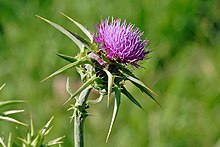 Milk thistle flowerhead http://goo.gl/m5bJw
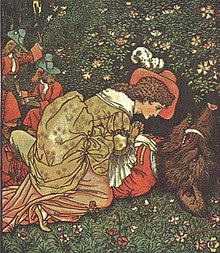 Illustration for Beauty and the Beast byWalter Crane.
 Francis Barlow's illustration of the fable, 1687
Comments
Post a Comment