Week 11: notes_ Cultural and Social Diversity (children literature)
|
Week 11
|
|
|
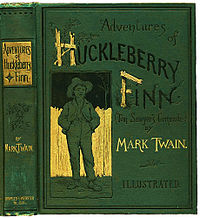
Adventures of Huckleberry Finn (or, in more recent editions, The Adventures of
Huckleberry Finn) is a novel by Mark Twain, first published in the United Kingdom in December 1884
and in the United States in February 1885. Commonly named among the Great American
Novels, the work is
among the first in major American
literature to be
written throughout in vernacular English, characterized by local
color regionalism. It
is told in the first person by Huckleberry
"Huck" Finn, a
friend of Tom Sawyer and narrator of two other Twain novels (Tom Sawyer
Abroad and Tom Sawyer,
Detective). It is a direct
sequel to The
Adventures of Tom Sawyer.
|
|
|
Youtube: http://goo.gl/hj22ix
|
Star light, star bright,
The first star I see
tonight;
I wish I may, I wish I
might,
Have the wish I wish
tonight
|
|
“I wish I could find Lowly.”
|
Conflict
l
Long and thin
l
Green hat
l
One shoe
|
|
Lyrics:
London Bridge is falling down,
Falling down, falling down.
London Bridge is falling down,
My fair lady.
Youtube:
|
"London
Bridge Is Falling Down" (also
known as "My Fair Lady"
or simply "London Bridge") is a traditional nursery rhymeand singing game, which is found in different versions all over
the world. It deals with the depredations of London Bridge and attempts, realistic or fanciful, to repair it. It
may date back to bridge rhymes and games of the late Middle Ages, but the
earliest records of the rhyme in English are from the seventeenth century.
The lyrics were first printed in close to its modern form in the
mid-eighteenth century and became popular, particularly in Britain and the
United States in the nineteenth century. The modern melody was first recorded
in the late nineteenth century and the game resembles arch games of the
Middle Ages, but seems to have taken its modern form in the late nineteenth
century. It has a Roud Folk Song
Index number of
502. Several theories have been advanced to explain the meaning of the rhyme
and the identity of the "fair lady" of the refrain. The rhyme is
one of the most well known in the world and has been referenced in a variety
of work of literature and popular culture.
|
|
Take the key and lock him up
|
|
|
Lyrics:
Mary had a little lamb,
Little lamb, little lamb,
Mary had a little lamb,
Its fleece was white as snow.
And everywhere that Mary went,
Mary went, Mary went,
Everywhere that Mary went,
The lamb was sure to go.
It followed her to school one day,
School one day, school one day,
It followed her to school one day,
That was against the rule.
It made the children laugh and play,
Laugh and play, laugh and play,
It made the children laugh and play
To see a lamb at school.
And so the teacher turned it out,
Turned it out, turned it out,
And so the teacher turned it out,
But still it lingered near...
And waited patiently about,
Patiently about, patiently about,
And waited patiently about,
Till Mary did appear.
"Why does the lamb love Mary so?
Mary so? Mary so?
Why does the lamb love Mary so?"
The eager children cry.
"Why, Mary loves the lamb, you know,
The lamb, you know, the lamb, you know!
Why, Mary loves the lamb, you know."
The teacher did reply.
(source: http://goo.gl/Gimio2
)
|
"Mary Had a
Little Lamb" is an English language nursery rhyme of nineteenth-century American origin. It has a Roud Folk Song
Index number of
7622.
Youtube: http://goo.gl/Chq6ND
|
|
Bare cupboard (from “Old Mother Hubbard”)
Lyrics:
Old Mother Hubbard
Went to the cupboard,
To give the poor dog a bone;
When she came there,
The cupboard was bare,
And so the poor dog had none.
She went to the baker's
To buy him some bread;
When she came back
The dog was dead!
She went to the undertaker's
To buy him a coffin;
When she came back
The dog was laughing.
She took a clean dish
to get him some tripe;
When she came back
He was smoking his pipe.
She went to the alehouse
To get him some beer;
When she came back
The dog sat in a chair.
She went to the tavern
For white wine and red;
When she came back
The dog stood on his head.
She went to the fruiterer's
To buy him some fruit;
When she came back
He was playing the flute.
She went to the tailor's
To buy him a coat;
When she came back
He was riding a goat.
She went to the hatter's
To buy him a hat;
When she came back
He was feeding her cat.
She went to the barber's
To buy him a wig
When she came back
He was dancing a jig.
She went to the cobbler's
To buy him some shoes;
When she came back
He was reading the news.
She went to the sempstress
To buy him some linen;
When she came back
The dog was spinning.
She went to the hosier's
To buy him some hose;
When she came back
He was dressed in his clothes.
The Dame made a curtsy,
The dog made a bow;
The Dame said, Your servant;
The dog said, Bow-wow.
This wonderful dog
Was Dame Hubbard's delight,
He could read, he could dance,
He could sing, he could write;
She gave him rich dainties
Whenever he fed,
And erected this monument
When he was dead.
|
"Old Mother Hubbard" is an English-language nursery rhyme, first printed in 1805 and among the most popular
publications of the nineteenth century. The exact origin and meaning of the
rhyme is disputed. It has a Roud Folk Song
Index number of
19334.
|
|
Theme
|
Lost/ Found
Dream/ Adventure
Magic/ Spell
Friendship/ Leadership
Describing/ Sorting/
Naming
|
|
Duty-free
(source: http://goo.gl/ftZaLy)
|
1. Exempt from customs duties: duty-free
merchandise.
2. Of, relating to, or being a region or
establishment in which imported goods are exempt from customs duties: a
duty-free port; a duty-free shop.
|
|
Off-duty
(source: http://goo.gl/z1habo)
|
1. Not engaged in or
responsible for assigned work.
2. Of or relating to the
periods when a person is not engaged in or responsible for assigned work.
|
 http://goo.gl/7UGSI
 http://goo.gl/w22fAM
 http://goo.gl/bWFbau
The Comic Adventures of Old Mother Hubbard and Her Dog; London : J. Harris; 1805. 1st state of 1st edition
Comments
Post a Comment