Week 10: notes_ Books of Early Childhood and Picture Storybooks (children literature)
|
Week 10
|
|
|
Dane Lane
|
Unfaithful
|
|
Mistletoe: Stand under it and kiss beneath
it, the two would love each other
|
Mistletoe is the
common name for obligate hemiparasitic plants in several families in the order
Santalales. These plants attach to and penetrate the branches of a tree or
shrub by a structure called the haustorium, through which they absorb water
and nutrients from the host plant.
|
|
“It’s the Most Wonderful Time of the Year”
Youtube: http://goo.gl/pXDpZd
|
Sung Andy Williams
A popular Christmas song written in 1963 by
Edward Pola and George Wyle. It was recorded and released that year by pop
singer Andy Williams for his first Christmas album, The Andy Williams
Christmas Album. However, the song was not released as a promotional single
by Williams' record label (Columbia Records) that year, as they instead opted
to promote his cover of "White Christmas" as the official promo
single from the album.
|
|
Recite the story
|
Lyrics (demonstrate
the stress of the syllable) 重音停留較久, 押韻
|
|
Be “of” good cheer
|
|
|
Season’s greeting
|
聖誕佳節
|
|
Come to call
|
拜訪
|
|
Fairy tale
|
Short story, fantasy
character, magic, enchantment
|
|
Eat human
An ogre (feminine ogress) is a being usually
depicted as a large, hideous, manlike monster that eats human beings. Ogres
frequently feature in mythology, folklore, and fiction throughout the world. They
appear in many classic works of literature, and are most often described in
fairy tales and folklore as eating babies.
|
|
|
Hooding ceremony (wiki answer)
|
正官儀式
|
|
A French author and member of the Académie
française. He laid the foundations for a new literary genre, the fairy tale, with his works derived from
pre-existing folk tales. The best
known of his tales include Le Petit Chaperon rouge (Little
Red Riding Hood), Cendrillon (Cinderella), Le Chat Botté (Puss in Boots), La Belle au bois
dormant (The Sleeping
Beauty) and La Barbe bleue (Bluebeard).[1] Many of Perrault's stories,
which were rewritten by theBrothers Grimm, continue to be printed
and have been adapted to opera, ballet (such as Tchaikovsky's The
Sleeping Beauty), theatre, and film (Disney). Perrault was an
influential figure in the 17th-century French literary scene, and was the
leader of the Modern faction during the Quarrel of the Ancients and the Moderns
|
|
|
Also called
the French Academy, is the pre-eminent French learned body on matters
pertaining to the French language.
The Académie was officially established in 1635 by Cardinal Richelieu,
the chief minister to King Louis XIII. Suppressed
in 1793 during the French
Revolution, it was restored in 1803 by Napoleon
Bonaparte. It is the oldest of the
five académies of the Institut de
France.
|
|
|
Little Red Riding Hood, or Little Red Riding
hood, also known as Little Red Cap or simply Red Riding Hood,
is a French and later European fairy tale about a young girl and
a Big Bad Wolf.
The story has been changed considerably in its history and subject to
numerous modern adaptations and readings. The story was first published
by Charles Perrault.
This story is number 333 in the Aarne-Thompson classification system for folktales.
|
|
|
Cinderella, or The
Little Glass Slipper, (French: Cendrillon,
ou La petite Pantoufle de Verre, Italian: Cenerentola,German: Aschenputtel) is a
European folk tale embodying a myth-element of unjust oppression/triumphant reward. The
title character is a young woman living in unfortunate circumstances that are
suddenly changed to remarkable fortune. The most popular versions were
published by Charles Perrault in Histoires ou contes du temps passé in 1697, and by
the Brothers Grimm in
their folk tale collection Grimms' Fairy
Tales.
|
|
|
"Master Cat; or, The Booted Cat"
(early French: Le
Maître Chat, ou Le Chat Botté), commonly known in English as "Puss in
Boots", is a French literary fairy tale about a cat who uses
trickery and deceit to gain power, wealth, and the hand of a princess in
marriage for his penniless and low-born master. The tale was written at the
close of the seventeenth century by Charles Perrault(1628–1703), a retired
civil servant and member of the Académie
française. The tale appeared in a handwritten and illustrated
manuscript two years before its 1697 publication by Barbin in a collection of
eight fairy tales by Perrault called Histoires ou contes du temps passé. The book was an
instant success and remains popular.
|
|
|
"The Sleeping
Beauty" (French: La
Belle au bois dormant "The Beauty sleeping in the Wood")
by Charles Perrault or
"Little Briar Rose" (German: Dornröschen) by the Brothers Grimm is a classic
fairytale involving a beautiful princess, enchantment of sleep, and a
handsome prince. Written as an original literary tale, it was first published
by Charles Perrault in Histoires ou contes du temps passé in 1697.
|
|
|
"Bluebeard" (French: La Barbe bleue) is a French
literary folktale, the most famous surviving
version of which was written byCharles Perrault and first published
by Barbin in Paris in January 1697 in Histoires ou Contes du temps passé. The tale tells the story
of a violent nobleman in the habit of murdering his wives and the attempts of
one wife to avoid the fate of her predecessors.Gilles de Rais, a 15th-century
aristocrat and prolific serial killer, has been suggested as the
source for the character of Bluebeard, as has Conomor the Accursed, an early Breton
king. "The White Dove", "Mister Fox" and "Fitcher's
Bird" are tales similar to "Bluebeard".
|
|
|
The term nursery rhyme is used for traditional
poems and songs for young children in Britain and many other countries, but
usage only dates from the late 18th/early 19th century and in North America
the term "Mother Goose Rhymes", introduced in the mid-1700s, is
still often used.
|
Nursery Rhymes: Lyrics,
Origins & History
|
|
Lullaby (song for children)
|
A lullaby is a soothing song, usually sung to young children before they go to
sleep, with the intention of aiding that process. As a result the songs are
often simple and repetitive. Lullabies can be found in many countries, and
have existed since ancient times.
Tonally, most lullabies are simple, often merely alternating tonic and dominant harmonies.
|
|
Pantomime (informally, panto), not to be
confused with the theatrical medium of mime, is a form of musical comedy stage production,
designed for families. It was developed in the United Kingdom and mostly performed
during the Christmas and New Year season. Modern pantomime includes songs,
slapstick comedy and dancing, employs gender-crossing actors, and combines
topical humour with a story loosely based on a well-known fairy tale.[1] It is a participatory form of
theatre, in which the audience is expected to sing along with certain parts
of the music and shout out phrases to the performers.
Pantomime has a long theatrical
history in Western culture dating back to classical theatre, and it developed
partly from the 16th-century commedia
dell'arte tradition of Italy, as well as other European and
British stage traditions, such as 17th-centurymasques.
|
|
|
William Wallace "W. W." Denslow (May 25, 1856 – May 27, 1915) was an
American illustrator and caricaturist remembered for his work in
collaboration with author L. Frank Baum, especially his illustrations of The
Wonderful Wizard of Oz. Denslow
was an editorial cartoonist with a strong interest in politics(reference
needed), which has fueled political interpretations of The Wonderful
Wizard of Oz.
|


"Sleeping Beauty", by Henry Meynell Rheam
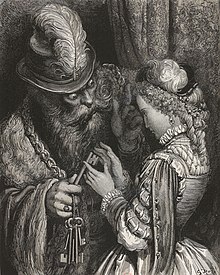 Bluebeard, his wife, and the keys in a 19th-century illustration by Gustave Doré
 Lullaby by François Nicholas Riss
 http://goo.gl/PFzTB4
 http://goo.gl/zrTW1
(source: http://goo.gl/2wVJtn http://goo.gl/0WBLz6 http://goo.gl/Mw5DL )
Comments
Post a Comment