Week 1: notes_ orientation_ history of English language (etymology)
Week 1
|
|
Invade
|
|
William I (Old
Norman: Williame I; c. 1028 – 9 September 1087), usually known as William the
Conqueror and sometimes William the Bastard, was the first Norman King of
England, reigning from 1066 until his death in 1087. The descendant of Viking
raiders, he had been Duke of Normandy since 1035 under the style William II.
|
|
7th century
|
Anglo and Saxons_ Germanic
(no longer spoke Celtics)
|
After William, the English spoke French (the
conqueror’s language)
|
They were Anglo-Saxons.
|
Anglo-Saxons
|
The Anglo-Saxons were Germanic tribes who
migrated to Britain from Jutland and Northern Germany beginning in the early
5th century. The Anglo-Saxon period denotes the period of English history
after their initial settlement through their creation of the English nation,
up to the Norman conquest; that is, between about 550 and 1066. The term
Anglo-Saxon is also used for the language, today more correctly called Old English,
that was spoken and written by the Anglo-Saxons in England and Eastern
Scotland between at least the mid 5th century and the mid 12th century, after
which it is known as Middle English.
|
Wales 的 (Celtics語的殘留)
Welsh (Cymraeg or y
Gymraeg, pronounced [kəmˈrɑːɨɡ, ə ɡəmˈrɑːɨɡ]) is a member of the Brythonic
branch of the Celtic languages spoken natively in Wales, by some along the
Welsh border in England, and in Y Wladfa (the Welsh colony in Chubut
Province, Argentina). Historically it has also been known in English as
"the British tongue", "Cambrian", "Cambric" and
"Cymric".
|
|
1944 Normandy landings
|
The Normandy landings, codenamed Operation
Neptune, were the landing operations of the Allied invasion of Normandy, in
Operation Overlord, during World War II. The landings commenced on Tuesday, 6
June 1944 (D-Day), beginning at 6:30 am British Double Summer Time (GMT+2).
In planning, as for most Allied operations, the term D-Day was used for the
day of the actual landing, which was dependent on final approval.
|
In the military,
D-Day is the day on which a combat attack or operation is to be initiated.
The best known D-Day is June 6, 1944 — the day of the Normandy landings —
initiating the Western Allied effort to liberate mainland Europe from Nazi
occupation during World War II. However, many other invasions and operations
had a designated D-Day, both before and after that operation.
|
|
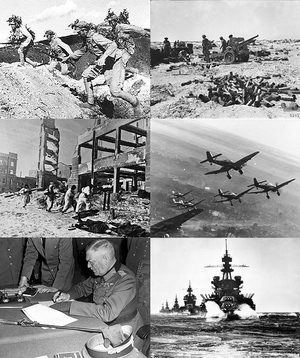
World War II (WWII or WW2), also known as the
Second World War, was a global war. It is generally considered to have lasted
from 1939 to 1945, although some conflicts in Asia that are commonly viewed
as becoming part of the world war had been going on earlier than that. It
involved the vast majority of the world's nations—including all of the great
powers—eventually forming two opposing military alliances: the Allies and the
Axis. It was the most widespread war in history, with more than 100 million
people, from more than 30 different countries, serving in military units.
|
|
Sep-: away from, apart
|
Select, separate,
segregate
|



(source: wiki)
Comments
Post a Comment